India’s dairy logistics system is undergoing a quiet but decisive transformation, and Amul is at the centre of this shift. For a company where freshness, speed, and cost efficiency are tightly linked, the move towards dedicated freight corridors (DFCs), the upcoming Dankuni-Surat corridor, and a network of 35 multimodal logistics parks are reshaping how milk travels across the country.
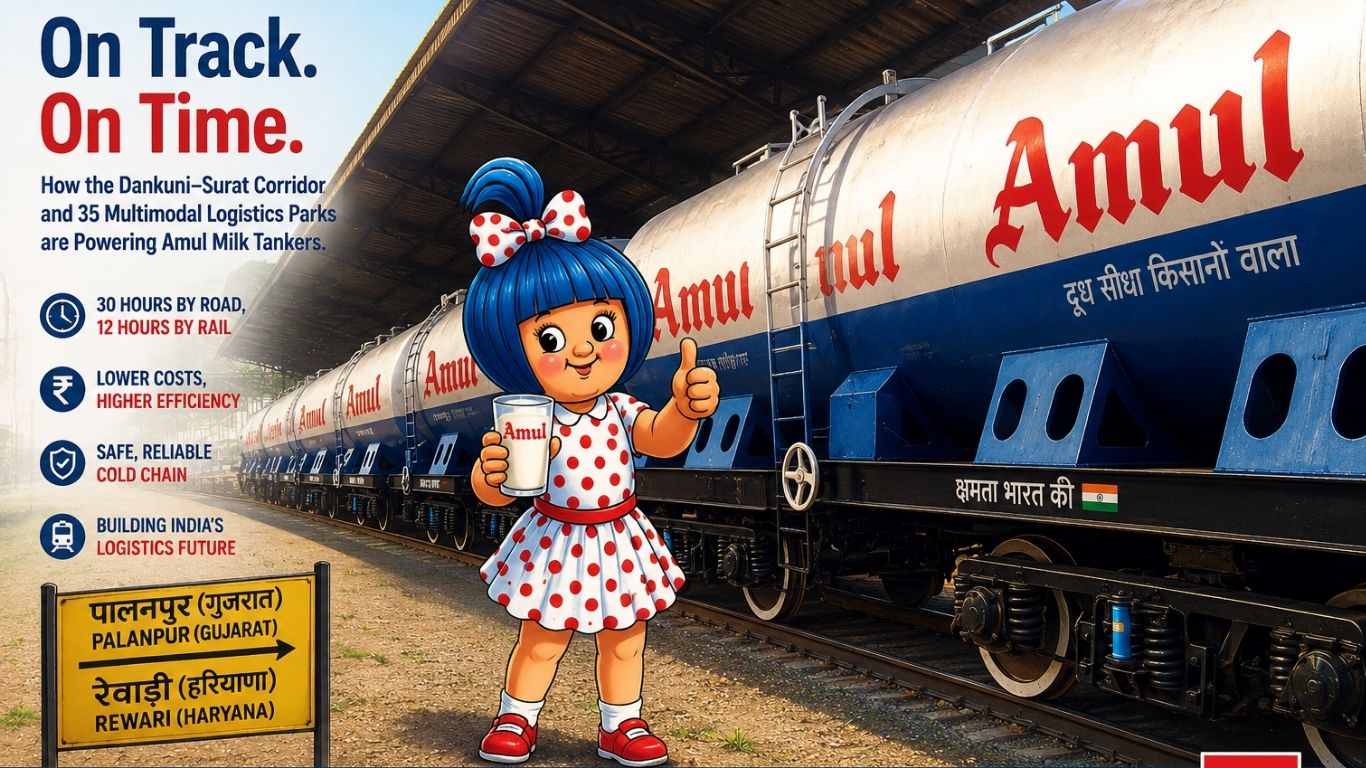
Amul’s logistics transformation is best captured in a single route. A milk tanker journey from Gujarat to Haryana that earlier took nearly 30 hours by road is now completed in just 12 hours. The company has shifted long-haul transport onto rail by loading tankers onto flat waggons at Palanpur in Gujarat. Every day, around 30 trucks are moved over a 636 km stretch to Rewari in Haryana via the Dedicated Freight Corridor. Drivers travel separately in a coach, while the milk remains temperature-controlled throughout the journey. The result is a reduction of 18 hours in transit time without altering the core supply chain.
Inside the Dedicated Freight Corridor Model
This efficiency comes from the design of the DFC network itself. Built exclusively for cargo, these corridors eliminate delays caused by passenger train traffic and highway congestion. There are no toll interruptions, reduced reliance on diesel for long hauls, and far greater predictability in arrival times. For Amul, this translates into lower fuel costs, fewer accidents, and consistent cold chain integrity. With milk attracting zero GST, the cost advantage becomes even sharper. The sourcing, processing, and distribution remain unchanged; the breakthrough lies in shifting long-distance movement from road to rail.
The upcoming Dankuni-Surat corridor is expected to extend this model across India’s east-west axis. Covering nearly 2,000 km, it will link production centres in the west with consumption markets in the east through a high-capacity freight network. For dairy logistics, this creates the ability to move surplus milk efficiently across regions, reducing supply-demand imbalances and enabling faster access to new markets. It effectively turns regional dairy operations into a more unified national grid.
Supporting this shift are the 35 multimodal logistics parks being developed across India. These facilities integrate rail, road, and warehousing infrastructure, often with built-in cold chain capabilities. For Amul’s milk tankers, this enables a hub-and-spoke model: milk is collected locally by road, transferred to rail at a logistics park for long-distance movement, and then redistributed via tankers at the destination. This reduces dependence on long-haul trucking while preserving last-mile flexibility. The presence of cold storage and mechanised handling also ensures that temperature-sensitive cargo like milk remains within safe limits during transfers.
Beyond Amul: A Blueprint for Perishable Supply Chains
The broader logistics landscape is also evolving in favour of such models. India’s logistics cost has fallen to 7.97% of GDP, down from 13-14% a few years ago, beating the government’s target of bringing it below 10%. Yet, nearly 70% of freight still moves by road, indicating a large opportunity for further optimisation. Companies that shift early to rail-integrated logistics stand to benefit the most from cost savings and operational efficiency.
Budget 2026-27 has accelerated this transition by announcing the Dankuni-Surat corridor and expanding the network of multimodal logistics parks. It also opens up a narrow window for investments in warehousing and cold chain infrastructure along these routes. As adoption grows, early movers are likely to secure lasting advantages.
The Road Ahead
Amul’s 12-hour milk run is not just an operational improvement; it signals a deeper structural change. The convergence of freight corridors and multimodal logistics parks is redefining how perishables move in India, making logistics not just faster but smarter and more reliable.
Source : Logisticsinsider