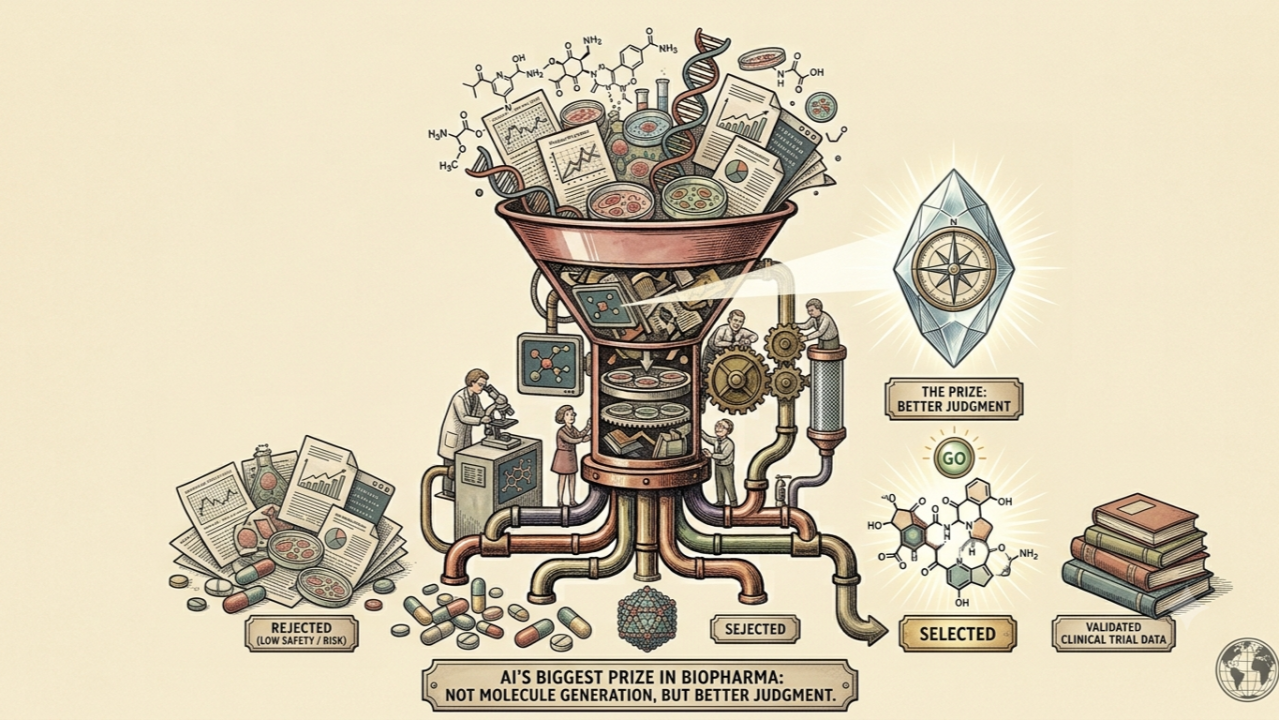
The pharmaceutical industry has spent the past several years asking whether artificial intelligence can generate better molecules. It is an understandable obsession. Molecules are tangible. They can be drawn, optimised, synthesised, patented, and licensed. They make good slides. They make good headlines. A model that can move from target to candidate faster than a traditional discovery team feels like the future arriving early.
But the more consequential question may be different.
The industry does not suffer from a shortage of molecules. It suffers from a shortage of high quality decisions under uncertainty.
That distinction matters. If AI only helps companies generate more compounds, it may add velocity to a system already crowded with plausible ideas. If, however, AI helps companies decide which targets deserve conviction, which indications deserve investment, which programmes should be stopped earlier, and which assets should receive disproportionate capital, then its impact could be much larger. The future of AI in biopharma may be less about inventing molecules and more about improving judgement.
The economics of drug development suggest why. A widely cited 2012 analysis in Nature Reviews Drug Discovery, led by the researcher Jack Scannell, described what the authors called Eroom’s Law, which is Moore’s Law spelled backward. The point was never that science had stopped advancing. Quite the opposite. Biology, chemistry, genomics, screening, structural methods, computation, and clinical operations have all improved markedly since 1950. Yet the number of new drugs approved per billion dollars of inflation-adjusted R&D spending has fallen by roughly 80-fold over the same period, while the cost of bringing a drug to market has roughly doubled every 9 years.
More recent industry analysis sharpens the point rather than softening it. Deloitte’s annual review of the top twenty biopharma companies puts the average R&D cost to progress an asset from discovery to launch at $2.23 billion in 2024, continuing a rise that has lasted more than a decade. Deloitte’s most recent report, the sixteenth in the series, found that the industry’s projected internal rate of return rose to 7.0% in 2025, a third consecutive year of improvement. That headline looks encouraging until it is unpacked. Strip out the GLP-1 and GIP mega blockbusters currently dominating late-stage pipelines, and the underlying return falls to 2.9%, down from 3.8% the year before. The industry is not becoming more productive across the board. A small number of exceptional bets are masking a broader decline, and portfolio value is concentrating into fewer, larger programmes whose failure would be correspondingly catastrophic. That is not a molecule problem. It is a portfolio construction problem, and it is getting worse rather than better.
To be clear, using AI to generate and design molecules is a genuine achievement, not a trivial one. The clinical data so far are encouraging. A 2024 analysis of the clinical pipelines of AI native biotech companies, conducted by researchers at Boston Consulting Group, found that AI-discovered molecules achieved an 80% to 90% success rate in Phase I trials, compared with a historical average closer to 40% to 65%. The same analysis found Phase II performance settling back to roughly 40%, comparable to historical norms, though on a still limited sample of ten completed trials. The clearest proof point to date is rentosertib, a TNIK inhibitor for idiopathic pulmonary fibrosis whose target and molecular structure were both generated by Insilico Medicine’s AI platform. Its Phase IIa results (GENESIS-IPF trial), published in Nature Medicine in June 2025, showed a meaningful improvement in lung function against placebo, the first peer-reviewed clinical readout for a molecule that AI touched from target discovery through to structure. BCG has separately modelled that AI-enabled workflows could reduce the time to a preclinical candidate by 30% to 50% and lower associated costs by up to 50%.
These are meaningful gains. They deserve attention. But they also reveal the boundary of the molecule generation story.
Phase I success usually tells us that a molecule can be made, dosed, exposed, and tolerated. It does not prove that the target is causal in human disease. It does not prove that the patient population is correctly selected. It does not prove that the biomarker is predictive, the endpoint is sensitive, the clinical effect is commercially meaningful, or the programme can beat the evolving standard of care. The industry rarely fails because it cannot imagine another chemical structure. It fails because biology is more complex than the original hypothesis, because animal models mislead, because clinical translation is weak, because the wrong indication is chosen, because evidence thresholds are softened by enthusiasm, or because capital keeps flowing after the probability of success has quietly deteriorated.
This is why portfolio prioritisation, not molecule generation, is the problem with the greatest leverage.
Molecule generation is, at its best, a local optimisation problem. It improves potency, selectivity, solubility, permeability, pharmacokinetics, safety margins, synthesis, and developability. Portfolio prioritisation is a global optimisation problem. It asks whether a programme deserves to exist inside a finite organisation with finite capital, finite talent, finite time, finite management attention, and finite credibility with investors.
This is where AI could become transformative.
Imagine a portfolio system that continuously integrates human genetics, disease biology, target validation, competitive intensity, modality fit, translational model relevance, biomarker strategy, trial feasibility, regulatory precedent, CMC complexity, patent density, payer relevance, and commercial differentiation. Such a system would not simply ask, “Can we make a drug against this target?” It would ask, “Should this programme receive the next $25 million before three other programmes do?”
That is a very different kind of AI.
It would be less glamorous than a generative chemistry engine. It would not produce colourful molecular renderings for investor decks. But it could do something more valuable. It could make assumptions explicit. It could reveal when a programme is being advanced because the biology is compelling, or because the team has already spent too much political capital to walk away. It could expose when a translational model is elegant but does not actually inform the decision at hand. It could show when a Phase II study is designed to detect a signal that would not change valuation, partnering interest, or clinical practice. It could quantify when the strongest argument for a programme is not evidence, but hope.
This is uncomfortable. It is also necessary.
Biopharma organisations often speak about killing programmes early, but incentives frequently point in the other direction. Teams are built around programmes. Careers become attached to assets. Scientific founders defend the biology that created the company. Investors want milestones. Boards want progress. Executives want optionality. In that environment, weak programmes rarely die because of a single obvious flaw. They drift. They accumulate caveats. They survive one more experiment, one more cohort, one more formulation attempt, one more translational assay, one more “informative” study.
This pattern has a name in the academic literature on drug development. A 2015 analysis in Nature Reviews Drug Discovery, by Richard Peck and colleagues, described the sunk cost bias, the accumulated time, money, and psychological commitment, that keeps failing programmes alive long after the underlying science has turned against them. The same authors argued for what they called quick kill strategies, which bring termination decisions forward to the earliest point the evidence allows.
AI will not solve the politics of portfolio governance. But it can make the politics harder to hide behind. The best use of AI in portfolio prioritisation is not to replace judgement. It is to discipline it.
That distinction is important. A naive version of this argument would say that AI should tell companies which programmes to fund. That is not realistic, and probably not desirable. Drug development involves ambiguity, tacit knowledge, human conviction, and moments where leadership must make asymmetric bets before all the evidence is available. But the current system often has the opposite problem. It rewards conviction and starves structured challenge.
AI can create a more rigorous decision architecture. It can turn scattered inputs into comparable evidence. It can test assumptions rigorously across functions. It can identify where the probability of technical success, regulatory success, commercial success, and strategic fit are diverging. It can help distinguish between an elegant experiment and one that actually creates value. It can also support earlier stop or go decisions, where the economic impact is greatest.
This is not a hypothetical benefit. AstraZeneca already proved the underlying principle, without needing AI to do it. Facing R&D productivity below industry averages, the company adopted in 2011 what it called the 5R framework, asking of every project whether it had the right target, the right tissue, the right safety margin, the right patient population, and the right commercial potential. Nothing about the framework was exotic. It was structured judgement, applied consistently and defended against the internal pressure to keep weak projects alive. Over the following five years, the proportion of AstraZeneca’s preclinical projects that survived through to the completion of Phase III trials rose roughly fivefold, from 4% to 19%, as the company’s own scientists reported in Nature Reviews Drug Discovery. The molecules were not fundamentally different. The discipline applied to choosing and killing programmes was. That is precisely the discipline AI, applied well, could scale across an entire industry rather than one company at a time.
This is especially relevant as the evidence base for drug development changes. In April 2025 the FDA published its roadmap to reducing animal testing in preclinical safety studies, and its stated rationale was blunt. More than 90% of drugs that clear animal studies still fail in humans, most often for safety or efficacy reasons the animal model never caught. The roadmap encourages sponsors to use New Approach Methodologies, including microphysiological systems, computational toxicology models, and advanced in vitro assays, beginning with monoclonal antibodies and expanding over time to other modalities. The agency’s own year one progress report, published in April 2026, confirmed it was ahead of its initial timeline, and the broader Operation TrialBlazer initiative launched by HHS in June 2026 shows that this direction has only accelerated since. That shift will create new forms of translational evidence. The harder task will not be generating NAMs data. It will be deciding how much confidence that data should carry in a portfolio decision, relative to a genetic association, a competitor’s failure, or a clinical biomarker.
This is where AI powered portfolio intelligence becomes powerful. The value is not in declaring that one assay, one model, or one dataset is definitive. The value is in connecting evidence across layers, human genetics, perturbation biology, iPSC derived systems, organoids, animal studies, clinical biomarkers, real world data, regulatory precedent, and competitive activity. A single dataset rarely creates conviction. Convergence does.
The same logic applies to business development, and the stakes of getting it wrong are rising. BCG has documented (see the figure above) that average premiums paid in biopharma licensing and acquisition deals climbed from roughly 50% in 2021 to 77% in 2023, as competition intensifies for a shrinking pool of validated assets. Companies do not merely need more assets to review. They need better ways to decide which assets merit diligence, which ones are overpromoted, which ones are strategically redundant, and which ones are underappreciated because the market has not yet connected the biology, patient segmentation, and regulatory pathway. Platforms that aggregate patents, clinical trials, literature, company disclosures, expert commentary, deals, and competitive movement are early signs of this shift. Their purpose is not to generate molecules. Their value is to improve the information environment in which portfolio and business development decisions are made.
This may be the more durable AI advantage.
If generative chemistry becomes broadly available, molecule generation will be partially commoditised. Many companies will be able to produce plausible structures. Many will claim faster design cycles. Many will show impressive preclinical packages. The strategic question will then move elsewhere. Which company understands the disease best, chooses the right patient population, designs the most decision relevant experiments, kills weak programmes fastest, and concentrates capital behind the strongest opportunities?
This is also why the term “AI drug discovery” is too narrow. The phrase pulls attention toward the earliest part of the value chain, where molecules are born. But much of the value in drug development is created later, through translation, prioritisation, capital allocation, clinical design, regulatory strategy, and disciplined execution. A molecule can be novel and still be strategically irrelevant. A programme can be scientifically interesting and still be a poor use of capital. A trial can be positive and still fail to support a differentiated product. AI that ignores these realities will accelerate activity without necessarily improving productivity.
The industry should therefore ask a harder set of questions.
The obvious question is whether AI can generate a molecule. The harder and more consequential questions follow close behind. Can it help us choose better targets? Can it tell us when the translational evidence is too thin? Can it expose competitive crowding before we overinvest? Can it identify the patient subset where biology, biomarkers, and clinical feasibility converge? Can it tell us which experiments would actually change the probability of success? Can it help boards and portfolio committees compare programmes using evidence rather than narrative force? Can it make the cost of continuing a weak programme more visible than the discomfort of stopping it?
These questions are less dazzling than molecule generation. They are also closer to how value is actually created.
The companies that win the next phase of AI-powered drug development may not be those with the largest molecule generation engines. They may be those that build the best decision engines, systems that integrate science, translation, competition, regulation, capital, and execution into a more honest view of risk and opportunity.
AI will generate molecules. Some will become drugs. That will matter. BUT, its largest impact may come from a quieter place. It may lie in helping biopharma organisations think more clearly about what deserves belief.
In an industry where every programme competes for capital, time, and conviction, better judgement is not a soft advantage. It is the advantage.
Source : linkedin – Mukhtar Ahmed