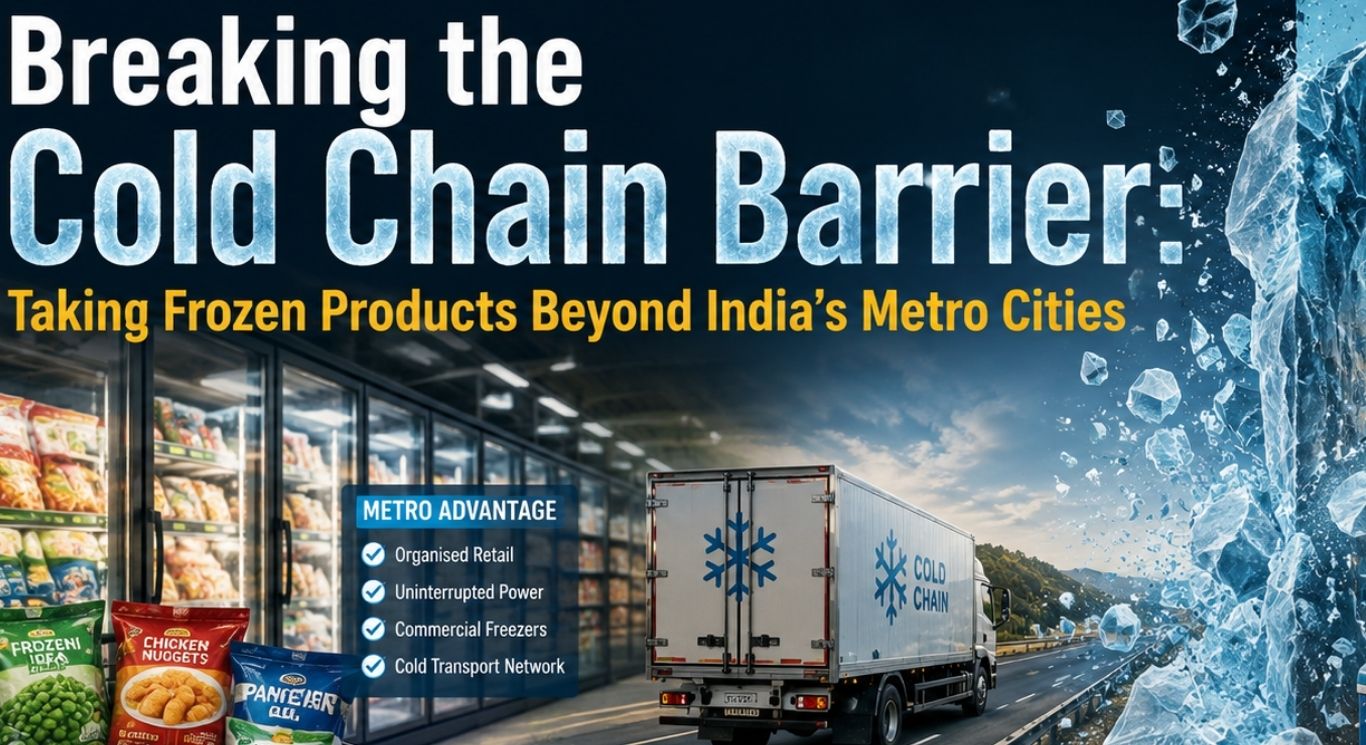
The frozen food business in India was largely an urban story. Consumer appetite was never really the constraint. What limited growth was logistics. Metro cities had everything this category needed: organised retail, uninterrupted power, commercial freezers and a functioning cold transport network. Move beyond these cities, and the same business became far harder to run profitably. That equation is now changing.
Smaller cities are seeing rising incomes, busier lifestyles and a genuine shift toward convenience foods. Consumers in these markets are ready to try frozen products. Companies are ready to invest behind them. What is missing, in most cases, is the infrastructure to connect the two.
In some ways, this is similar to what e-commerce went through a decade ago, where consumer demand moved well ahead of the systems needed to support it.
Demand has grown faster than the cold chain
There is enough evidence today to show that frozen food is no longer a niche purchase. Ready-to-cook snacks, frozen vegetables and meal components are becoming part of regular kitchen use, particularly among consumers who value convenience as much as taste.
Industry estimates put India’s frozen foods market on a growth path of nearly 14.5 per cent CAGR between 2025 and 2035. But rising demand only matters if supply can keep pace with it, and this is where the real challenge begins.
Frozen food, unlike most packaged categories, has very little room for error. A break in temperature at any stage, whether in storage, transport or at the retail point, can affect product quality before it reaches the consumer. This is why cold chain is not simply a support function for this business. It is the business.
India’s cold storage network has expanded steadily over the years. By mid-2025, the country had more than 8,800 cold storage facilities with a combined capacity exceeding 40 million metric tonnes, according to the National Centre for Cold-chain Development. Even so, the industry estimates a capacity shortfall of nearly 35 million metric tonnes. The bigger concern is that much of this infrastructure is concentrated in a handful of states, leaving vast parts of the country with limited cold-chain support.
The task ahead, therefore, is not simply about adding more cold storage. It is about building an integrated system, one where warehouses, refrigerated trucks, regional hubs and retail freezers function as a single connected network rather than isolated pieces.
Demand from Bharat is already here
One of the more significant shifts in this industry has been the changing profile of the consumer. Frozen food is no longer a Delhi, Mumbai or Bengaluru phenomenon. Cities such as Lucknow, Indore, Coimbatore, Guwahati and Bhubaneswar are showing strong demand as organised retail expands and household incomes rise.
Quick commerce has played a meaningful role in accelerating this shift. Consumers have also become far more comfortable buying frozen food online. What was once largely picked up during a supermarket visit is now being added to quick commerce orders alongside milk, bread and other daily staples. That shift is already visible in the numbers. Redseer estimates that the frozen ready-to-cook category across India’s three largest quick commerce platforms grew from about US$200 million in 2024 to nearly US$376 million in 2025. Frozen vegetable snacks accounted for the biggest share of sales.
That said, quick commerce tells only part of the story. Its model works well in cities where supporting infrastructure already exists. Reaching the next 200 million consumers will depend on something less visible but far more critical: reliable refrigerated logistics that extend well beyond the major cities.
This is where the next phase of growth in this industry will actually be decided.
The next advantage will not sit on a supermarket shelf
Food companies are already positioning themselves for this shift. Investment in frozen product portfolios, manufacturing capacity and regional distribution has picked up meaningfully, a clear sign that companies expect future growth to come increasingly from outside the metros. Government support for integrated cold chain and food processing infrastructure has added further momentum to this shift.
According to the Ministry of Food Processing Industries, 395 integrated cold chain projects have been approved so far, of which 291 are already operational. Together, these projects have created preservation capacity of more than 25 lakh metric tonnes and generated close to 1.74 lakh jobs.
These numbers matter because the basis of competition in this industry is changing. Companies have traditionally competed on product innovation, pricing or distribution reach. Increasingly, the ability to maintain consistent product quality across longer distances is becoming just as important. As consumers begin to expect the same experience regardless of where they live, cold chain is shifting from an operational requirement to a genuine strategic differentiator.
India’s frozen food opportunity will not be defined by what happens inside a processing facility. It will be shaped by everything that happens once a product leaves it.
Companies that invest in building dependable cold chain networks today will do more than expand their reach to new pin codes. They will help open up a market that has been ready for some time now, one that was never really waiting for demand to show up, but for the infrastructure to finally catch up with it.
Source : Logisticsinsider