For Vijay Patil, a cancer specialist at Mumbai’s PD Hinduja Hospital, it was another painful day. A 72-yearold patient from Dahanu, a city suburb, had come to him with advanced small-cell lung cancer. The standard drug marketed by a multinational company was beyond the patient’s reach, putting Patil in an awkward situation.
However, there was an alternative. He prescribed a newly approved, lower-cost alternative immunotherapy that was developed in China and sold in India through a local partnership.
“Administered alongside chemotherapy, it delivered a strong clinical response within four cycles,” says an elated Patil. “The patient has since transitioned to maintenance immunotherapy and remains stable,” he adds, highlighting how affordable innovation can improve cancer care outcomes in India.
This underscores a broader shift in India’s oncology landscape, where more affordable immunotherapy options-particularly emerging from India-China collaborations- have begun to expand access for patients previously priced out of treatment.
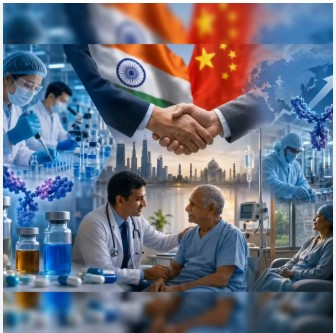
Patil is not an exception. An increasing number of doctors in India are treating cancer patients with a raft of latest-generation drugs invented in Chinese labs and imported through tie-ups with Indian companies.
Doctors see this as a quiet disruption where Chinese medicines available at a fraction of the price-are filling gaps created due to exorbitant pricing of Western-origin immunotherapy drugs. This change will enable better and more affordable treatment options, improving adherence to long-term cancer care, experts say.
CHINA LOWERS THE WALL
Families across economic strata in India are pushed to catastrophic financial toxicity.A study published in The Lancet says 34-84% of patients in India incur catastrophic expenditure on cancer care. Government funding covers only a quarter to a third of treatment costs, resulting in high out-of-pocket payments.
Sunil Chopade, medical and haemato-oncologist at Mumbai’s Jaslok Hospital, says twothree immunotherapy molecules have shown good results in studies in China and they need to be adopted in India. Immunotherapy trains the body’s own immune cells to identify, target and kill cancer cells or tumours.
“These are currently approved in India for indications like solid tumours, lung cancers, nasopharyngeal cancer and triple negative breast cancer,” says Chopade. The key driver behind the big shift to Chinese medicines is the cost of treatment, he says, adding that western-origin immunotherapies, such as nivolumab (Opdivo/Opdyta of Bristol Myers Squibb) and pembrolizumab (Keytruda of MSD), to name a few, have historically been prohibitively expensive in India.
Keytruda, used in the treatment of many forms of cancer, can cost 1-2 lakh for each vial and Opdivo/Opdyta ₹50,000-100,000, depending on the dose. Although multinational companies provide assistance programmes or subsidised pricing to some patients, based on income levels, many are left out and their families end up in a distressed financial state.
Meanwhile, locally produced biosimilars or approved versions of patented biotech-based medicines offer some hope. For example, nivolumab (branded Tishtha) was recently launched by Zydus Lifesciences at a price that is 75% lower than Opdivo’s, but due to high demand, patients say it is not widely available.
In the absence of viable alternatives, patients often fall prey to spurious cancer drugs that have penetrated the distribution chains in hospitals. Others get hold of cheap medicines illegally imported from Bangladesh that are not tested in Indian patients or approved by regulatory agencies.
It is in this scenario that Chinese drugs have lowered the price wall: they cost around ₹50,000 per immunotherapy session. That is not exactly cheap but is more affordable than a Western medicine that costs 200,000-500,000 per session. Although there were apprehensions about the quality, suitability and adoption of Chinese drugs in Indian patients, oncologists like Chopade say the responses are good. “The combined effect of Chinese-origin therapies and Indian generics is already influencing treatment patterns. Otherwise, it is very difficult to offer a molecule (drug) costing 4-5 lakh per session,” he says.
WORLD OF DIFFERENCE
Indian pharma companies are utilising this opportunity. Last year, Ahmedabad-based Intas Pharma launched Hetronifly (serplulimab), licensed from China’s Shanghai Henlius Biotech, to treat advanced small cell lung cancer. In the same year, Glenmark licensed Tevimbra (tesilizumab) from Beigene to treat lung cancer and oesophageal squamous cell carcinoma. In 2023, Dr Reddy’s Labs struck a deal with Shanghai Junshi Biosciences to sell Zytorvi (toripalimab) to treat nasopharangeal carcinoma. The deal covers 21 countries, including Brazil.
Patil says collaborations between India and China, along with Indian biosimilars, have increased the penetrability of immunotherapy in India. “Most one-year courses with MNC drugs are priced at around 10 lakh even after patient assistance schemes; otherwise the cost would be around ₹64-68 lakh. Indian and Chinese-linked options bring this down to around 3.5-4.5 lakh,” says Patil.
He argues that with the use of low-dose strategies, where patients are given infusions below the prescribed full dose, the cost can be brought down to 2 lakh per year: “At low dose, one session can be about 12,000, so this has become much more affordable.”
He and Kumar Prabhash, an oncologist with Mumbai’s Tata Memorial Hospital, argue in a 2022 paper in Ecancermedicalscience that low-dose immunotherapy is a cost-effective strategy to expand access to cancer care. They say fixed, lower doses of checkpoint inhibitors can act as a potentiator to standard chemotherapy, improving treatment response without requiring full-dose regimens.
This, the paper notes, is particularly relevant in lowand middle-income countries, where access remains severely constrained due to costs, with some estimates suggesting that only 1-3% of patients who need immunotherapy are able to receive it.
Worries about the quality of drugs from China are misplaced, says Patil, emphasising none of these drugs has a backdoor entry and goes through standard randomised phase-3 clinical trials. “In terms of response rates, progression-free survival and overall survival rates, they are similar to other immunotherapy agents.”
The combination of the two Asian countries has intensified over the last three years. While Chinese biotech companies are focused on US and European markets for rich returns from an insurance reimbursed payor model, India’s vast population offers the advantage of volumes and a wealth of data for clinical development. For Indian firms that lagged in building a pipeline of innovative medicines, joining Chinese companies to sell new drugs gives an additional stream of revenue.
“In less than a decade, Chinese medicines will mostly replace US and European products,” predicts a senior executive from a leading Indian pharmaceutical company, requesting not to be identified.
IT’S RAINING DEALS
For over a decade, marquee names from Pfizer to GSK and Eli Lilly have been in a race to develop drugs acquired from agile and efficient Chinese biotech firms. And it is not limited to cancer drugs. A report in South China Post says Chinese firms signed 157 out-licensing deals worth $135.7 billion in 2025, compared with 94 deals worth $51.9 billion in 2024.
The Chinese have the backing of deep research and a fast-tracked regulatory approvals system. They need the marketing depth of Indian companies to sell them.
“A shift towards Chinese medicines is evident across categories-peptides, oligonucleotides and CAR-T cell therapies. Neither US nor Europe is a match for China,” says the senior executive quoted above.
Chinese biotech companies are relentlessly adding more cancer drugs to their clinical development pipeline and Indian firms are moving in tandem to clinch deals.
Last September, Glenmark signed a deal with the Chinese company Jiangsu Hengrui to secure exclusive rights for select markets, including India, to develop a drug called trastuzumab rezetecan, a breakthrough lung cancer drug. The size of the deal exceeds a billion dollars, with Glenmark agreeing to make an upfront payment of $18 million, with staggered milestone payments and royalties. An antibody drug conjugate (a combination of a chemotherapy drug that kills the tumour and a monoclonal antibody that helps finds those cancer cells), trastuzumab rezetecan is approved in China for lung cancer while it is awaiting reviews for use in breast cancer patients.
If cleared for markets like US and Europe, Jiangsu Hengrui’s drug will be pitted against Enhertu, an injectable blockbuster developed by AstraZeneca and Daiichi Sankyo. Last year, it grossed sales of about $5 billion.
Glenmark is among the first few to spot the opportunity to team up with Chinese innovative drug makers. In 2024, it announced a deal with Jiangsu Alphamab and 3D Medicines for envafolimab, an advanced cancer treatment, for markets such as India, West Asia, Africa, Russia and Latin America. In 2025, Glenmark announced it would start a multi-country phase-3 clinical trial for the drug in patients with a common type of lung cancer.
In December, the Mumbai-based company signed with Jiangsu Hansoh yet another deal that could cumulatively exceed a billion dollars in payments for the development and commercialisation of another lung cancer drug, aumolertinib.
A Glenmark spokesperson says, “Our oncology strategy is anchored in one objective: expanding access to high-quality, differentiated cancer therapies for patients who need them most.” She adds: “We are building this through a combination of our own innovation-including assets such as ISB 2001, our tri-specific T-cell engager for multiple myeloma, for which Glenmark retains rights in emerging markets-and carefully selected global partnerships across geographies.”
On the deals with Chinese firms, she says, “Our collaborations for therapies such as envafolimab, trastuzumab rezetecan and aumolertinib reflect that approach. These are science-led partnerships where we evaluate each asset on the strength of its clinical data, differentiation, regulatory pathway and potential to address unmet patient needs.”
Industry experts believe Indian companies can play a meaningful role as partners that combine development, regulatory, manufacturing and commercial capabilities with deep understanding of emerging markets.
In February, Dr Reddy’s signed a deal with Shanghai Henlius to develop a biosimilar version of daratumumab, a highly prescribed monoclonal antibody for multiple myeloma, in intravenous and subcutaneous forms. The deal covers markets like US and Europe. In 2023, Mankind Pharma signed a deal with Innovent Biologics for an immuno-oncology drug that can be used for several cancer types.
The growing Chinese partnerships are not just in cancer medicines but also other chronic conditions like diabetes and obesity. In December, Lupin announced a deal with Gan & Lee for bofanglutide, a twice-a-month injectable GLP-1 drug for diabetes and weight loss, a segment that has seen a surge in M&As over the last five years.
Source : Economictimes