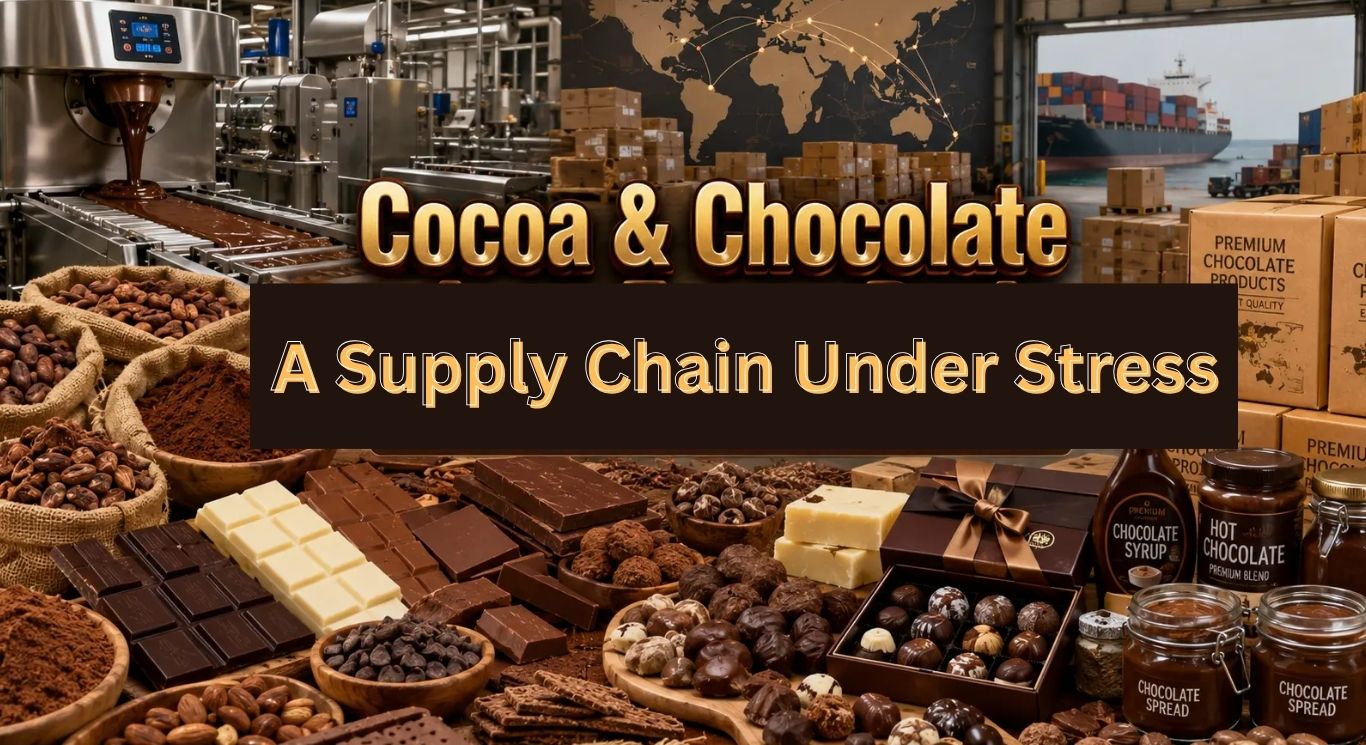
India is just days away from Diwali, while the West prepares for Halloween. Chocolate is definitely on the shopping list, from festive hampers to seasonal treats. But the sweet indulgence is turning increasingly bitter as cocoa prices fluctuate and the supply chain behind chocolate faces mounting pressure.
From struggling West African farms and fertilizer shortages to shipping disruptions and stricter traceability rules, the journey from cocoa farm to chocolate bar is becoming increasingly difficult to manage.
The price rollercoaster
Cocoa prices highlight the industry’s growing uncertainty. After trading largely between $1,000 and $3,500 per tonne for much of the preceding two decades, prices hit a record $12,565 in December 2024. They subsequently fell to around $3,161 in March 2026 before rising again. By early October 2026, New York cocoa futures were reportedly near $5,670 per tonne.
NBC News, citing a PwC data also notified of price increase in chocolates by 15.5%.
For manufacturers, this volatility complicates procurement budgets, inventory planning and pricing decisions. Buying too early risks locking in high costs, while delaying purchases can expose companies to further increases or shortages. Forecasting and supply risk management are becoming as important as securing competitive prices.
A global industry dependent on one region
West Africa accounts for roughly 70% of global cocoa production, with Côte d’Ivoire and Ghana central to the trade. This concentration leaves the industry vulnerable to adverse weather, crop disease, ageing plantations and declining productivity.
Replacing lost supplies is not easy. New plantations take years to mature, while alternative sourcing regions may lack the capacity to meet global demand. Diversification can reduce exposure, but buyers must also consider bean quality, consistency, transportation costs and supplier reliability.
The squeeze on cocoa farmers
Supply risks begin at the farm level. Farmers must maintain plantations and purchase fertilizer, often before knowing the returns their harvest will generate.
Research cited in the supplied material indicates that Côte d’Ivoire reduced its cocoa farmgate price, while 73% of surveyed farmers had not purchased fertilizer for the next two crop cycles. If confirmed, these figures point to a longer-term concern: farmers struggling to afford essential inputs may see productivity suffer, further constraining future supply.
Geopolitical tensions add another complication. Disruptions affecting fertilizer production and shipments through the Strait of Hormuz can increase costs or delay agricultural inputs reaching West African farmers. This illustrates how a crisis thousands of kilometres away can influence farm productivity and, ultimately, cocoa availability.
From harvest delays to port congestion
Harvesting cocoa is only the first step. Beans must pass through collection networks, storage facilities and export ports before reaching international buyers.
The supplied research cites a warning that Côte d’Ivoire’s new season could begin eight to ten weeks late, potentially affecting cargo flows through Abidjan and San Pedro.
Delayed arrivals can complicate vessel bookings, shipment schedules and inventory planning. Manufacturers may face uncertainty over raw material deliveries, while exporters and shipping lines must coordinate around changing cargo volumes. For buyers, the challenge is balancing inventory costs against the risk of production interruptions.
Traceability becomes a supply chain requirement
Physical disruptions are not the industry’s only concern. The European Union’s Deforestation Regulation introduces additional requirements for cocoa and specified derived products, including deforestation-free criteria and due diligence.
Under the current implementation timeline, the rules apply from 30 December 2026 to large and medium-sized operators, with most micro and small operators covered from 30 June 2027.
Businesses supplying the European market must prepare for stronger origin tracking, reliable documentation and greater visibility across sourcing networks. Where cocoa passes through multiple intermediaries, collecting and maintaining accurate information can be challenging.
Traceability is therefore becoming an integral part of procurement and supplier management, rather than simply a compliance exercise.
Building resilience beyond the price cycle
No single intervention can resolve these challenges. Better demand forecasting, diversified sourcing, stronger supplier relationships and closer coordination between procurement, logistics and manufacturing teams can help companies manage uncertainty. Supporting farm productivity and improving traceability are equally important to securing more reliable long-term supplies.
The consequences may eventually reach consumers through price increases, smaller packs or reformulated products, although the impact will vary by manufacturer and market.
What is breaking the chocolate supply chain is the convergence of price volatility, farm-level pressures, geopolitical risks, shipping uncertainty and regulatory demands.
Source: Logisticsinsider