CULTIVATION OF genetically modified (GM) crops in India has not progressed beyond cotton. Even there, no new technology has been approved for commercialisation since Monsanto’s Bollgard II Bt cotton in May 2006. But this isn’t so with genome edited (GE) crops.
In May, two GE rice lines were identified for release, after two years of trials to evaluate their field performance in the 2023 and 2024 kharif seasons under an All-India Coordinated Research Project.
The two lines were improved GE mutants of the popular Samba Mahsuri and MTU-1010 varieties, with the first one claimed to have demonstrated an average 19% yield increase over the former and the second making the latter amenable to grow well in saline and alkaline soils.
There is also a third GE line, in mustard, undergoing the second year of trials in 16 locations in the 2025-26 rabi crop season. If the results are good, this variety — a canola-quality low-pungent mustard that is simultaneously resistant to major fungal pathogens and pests — would be ready for release by around August 2026.
GE versus GM
GM crops contain foreign genes from unrelated species — say the Bacillus thuringiensis or Bt soil bacterium that code for the production of proteins toxic to various insect pests in cotton. GE, on the other hand, entails mere “editing” of genes naturally present in the host plant, leading to mutation or changes in their DNA sequence.
The editing is done by protein enzymes that act like “molecular scissors” to cut and modify the DNA of the targeted native gene. Such editing is aimed to bring forth desirable alterations in that gene’s expression and function. The enzyme is directed to the specific location/address in the plant genome by a “navigator” guide-RNA, which is a custom-designed molecule having a sequence matching that of the target DNA.
For developing the GE rice and mustard varieties, scientists used so-called CRISPR-associated Cas proteins. The Cas9 protein was deployed for editing a drought and salt tolerance gene in the MTU-1010 rice and 10 “glucosinolate transporter” genes in the Varuna mustard varieties. The Cas12a protein was, likewise, used to edit the cytokinin oxidase 2 (also called Gn1a) gene in Samba Mahsuri rice.
SOURCE: INDIAN COUNCIL OF AGRICULTURAL RESEARCH
To understand the objective behind editing, take the Gn1a gene: It codes for an enzyme that degrades cytokinin, a plant hormone stimulating the formation of rice spikelets or flowers. The more the cytokinin accumulation, the greater the number of spikelets that develop into grains. By reducing the expression of the Gn1a gene, the degradation of cytokinin is lowered, leading to an increased number of grains per panicle (flower cluster) and thereby yields.
Policy push
GE plants, being “free from exogenous introduced DNA”, have been exempted from the Ministry of Environment, Forest & Climate Change’s (MoEFCC) stringent biosafety assessment regulations.
These regulations apply to GM crops, whose “environmental release” requires commercial cultivation but even field trials and seed production is contingent upon clearance from a Genetic Engineering Appraisal Committee under the MoEFCC.
The exemption limits approvals for GE crops only at the level of an Institutional Biosafety Committee. The less stringent regulations — treating them virtually on par with conventional plant varieties — apart, the Narendra Modi government has provided funding support for GE crop research and breeding.
“The work to improve the two major rice varieties was initiated in 2018 through
Key Point
GE plants, being “free from exogenous introduced DNA”, are exempted from the Ministry of Environment, Forest & Climate Change’s stringent biosafety assessment regulations.
These regulations apply only to GM crops
the National Agricultural Science Fund. This was followed by an allocation of Rs 500 crore in the 2023-24 Union Budget,” said DK Yadava, deputy director-general (crop science) at the Indian Council of Agricultural Research (ICAR).
The Rs 500-crore provision included Rs 310 crore for field crops, Rs 120 crore for horticulture, Rs 40 crore for animal science, Rs 20 crore for fisheries and Rs 10 crore for editing of microorganisms.
ICAR scientists have identified target genes associated with specific traits in a host of crops (see chart).
“In all, we have identified 178 genes in 24 field crops (cereals, pulses, oilseeds, cotton, sugarcane, jute and tobacco) for editing. Similarly, there are 43 target genes identified in 16 horticultural crops (vegetables, fruits and spices),” Yadava told The Indian Express.
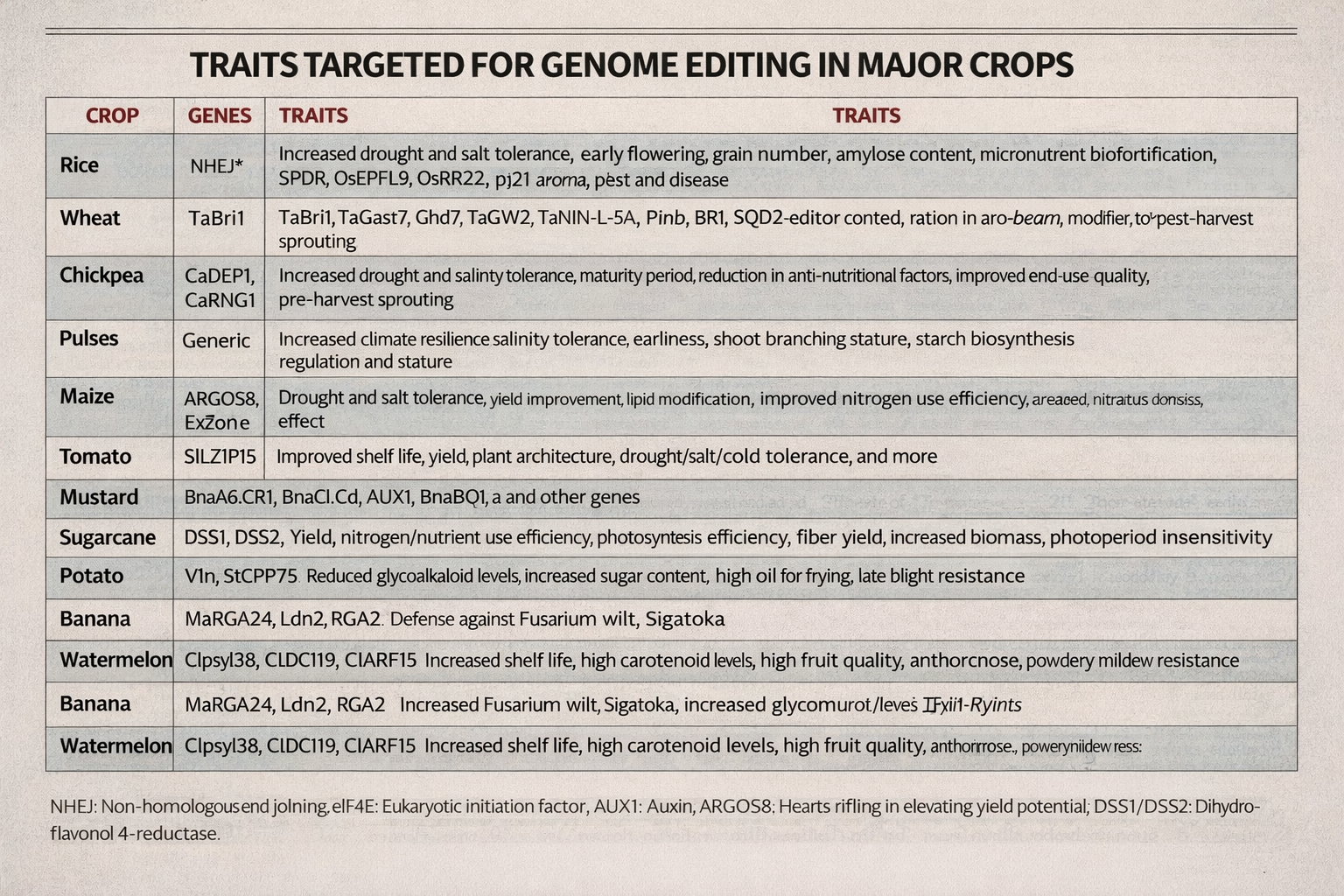
The genes have been selected for their determining or influencing particular traits of interest. “In many of these crops, the genome sequence is available. We know all the genes and the location of each of them on a specific chromosome of that plant’s genome. Once the functionality of a gene is established, it can be targeted and edited,” explained Yadava.
Human resource development
GE crop development requires both money and trained manpower.
“So far, nine scientists from various ICAR institutes have been sent for advanced training in the US, Europe, Australia and CIMMYT (International Maize and Wheat Improvement Center, Mexico). Another 12 are going in the coming months,” said C Viswanathan, joint director (research) of the New Delhi-based Indian Agricultural Research Institute (IARI).
In February, 10 scientists from the Innovative Genomics Institute — founded by the American biochemist Jennifer Doudna, who won the 2020 Nobel Prize in Chemistry for co-development of CRISPR-Cas9 GE technology with the French microbiologist Emmanuelle Charpentier — conducted training sessions for the faculty and students at IARI.
Besides, a team led by Kunjbihari Lal Meena, joint secretary at the Central Rice Research Institute, Cuttack (Odisha), has patented an indigenous “miniature alternative” GE tool to precisely cut and tweak the DNA of plants. This technology uses Tn5 or Transposon-associated proteins sourced from another bacteria. The inventors claim it to be cheaper (because of the intellectual property rights not being held by foreign entities) and more effective (due to the protein size being significantly smaller than Cas9 and Cas12a).
Source : indianexpress