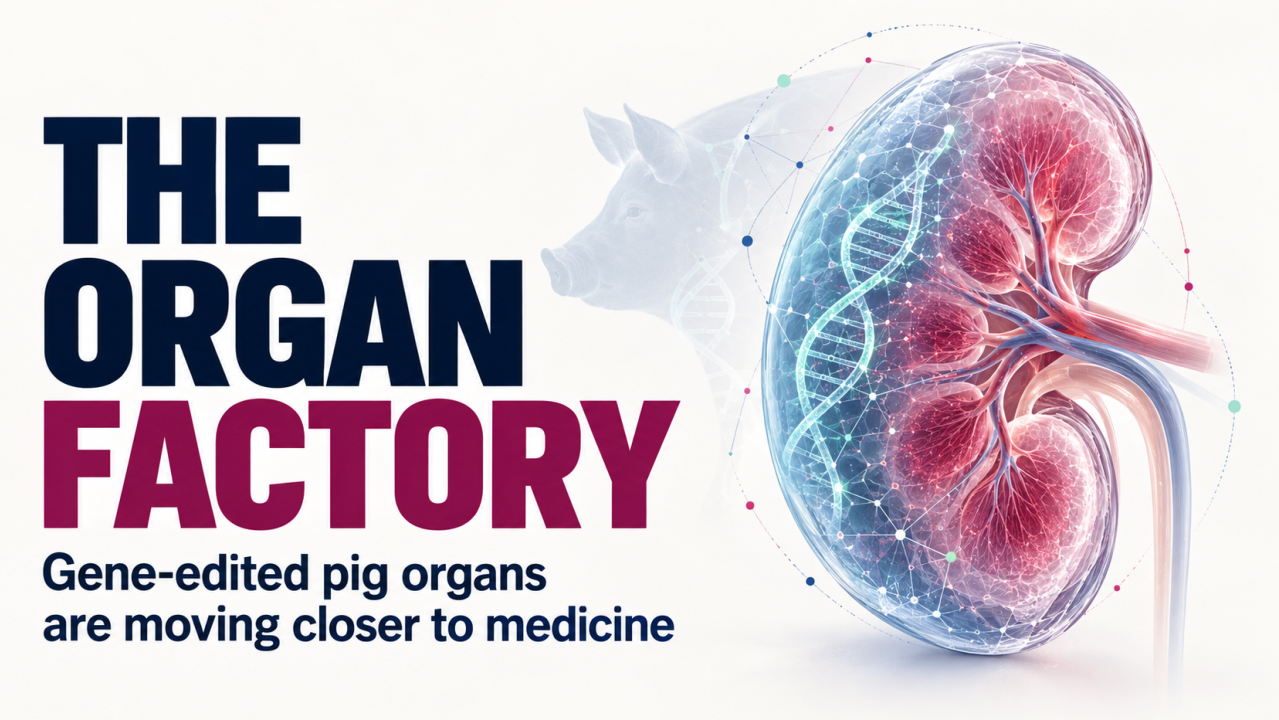
A widely reported case has moved xenotransplantation from an experimental possibility towards a serious clinical question.
In January 2025, 66-year-old Tim Andrews received a genetically edited pig kidney. It functioned for 271 days without dialysis—the longest reported dialysis-free survival after pig-kidney xenotransplantation in a living person. After the organ developed microvascular injury and progressive inflammation, it was removed. Andrews later received a deceased-donor human kidney with immediate graft function.
This was the first reported transition from a pig-kidney xenotransplant to a human kidney transplant. It shows that an animal organ may serve as a temporary bridge while a patient waits for a human donor. However, this remains an early, single-patient study—not proof that xenotransplantation is ready for routine clinical use.
What remains unsolved?
Preventing immune rejection and microvascular injury over longer periods
Managing immunosuppression when the patient develops an infection
Excluding animal-to-human pathogen transmission
Deciding whether xenotransplants should remain bridge therapies or become permanent replacements
Establishing ethical, regulatory and animal-welfare limits
Making such treatment safe, scalable and affordable
Questions for the MetaG1 community
Should xenotransplantation initially be developed only as a temporary bridge, or also as a permanent treatment?
Which is now the greatest scientific barrier: immune rejection, vascular injury, infection risk or genetic engineering?
How much clinical evidence should be required before this enters standard medical practice?
What ethical limits should govern breeding and genetically modifying animals for human organs?
Could India develop credible capability in this field? What biological, regulatory and clinical infrastructure would be necessary?
This case is important not because the problem is solved, but because it shows more precisely what must be solved next.
Verified sources
Mass General Brigham: How a pig-kidney xenotransplant served as a bridge to human transplant
Harvard Medical School: Patient Who Received Pig Kidney Becomes First to Progress to Human Kidney Transplant
Source: Community