Hold two facts in your mind at the same time.
Fact one: HTBt cotton saves Indian farmers approximately ₹7,000 to ₹8,000 per acre in manual weeding costs through its glyphosate-tolerance gene. Beyond weed management, much of the illegal HTBt seed circulating in Indian markets is being informally stacked with unapproved traits — including newer insecticidal proteins — that farmers are deploying to combat pink bollworm, precisely because approved Bt strains are struggling to contain the pest. Farmer organisations across Maharashtra, Gujarat, Telangana, and Andhra Pradesh are demanding legal access to this technology.
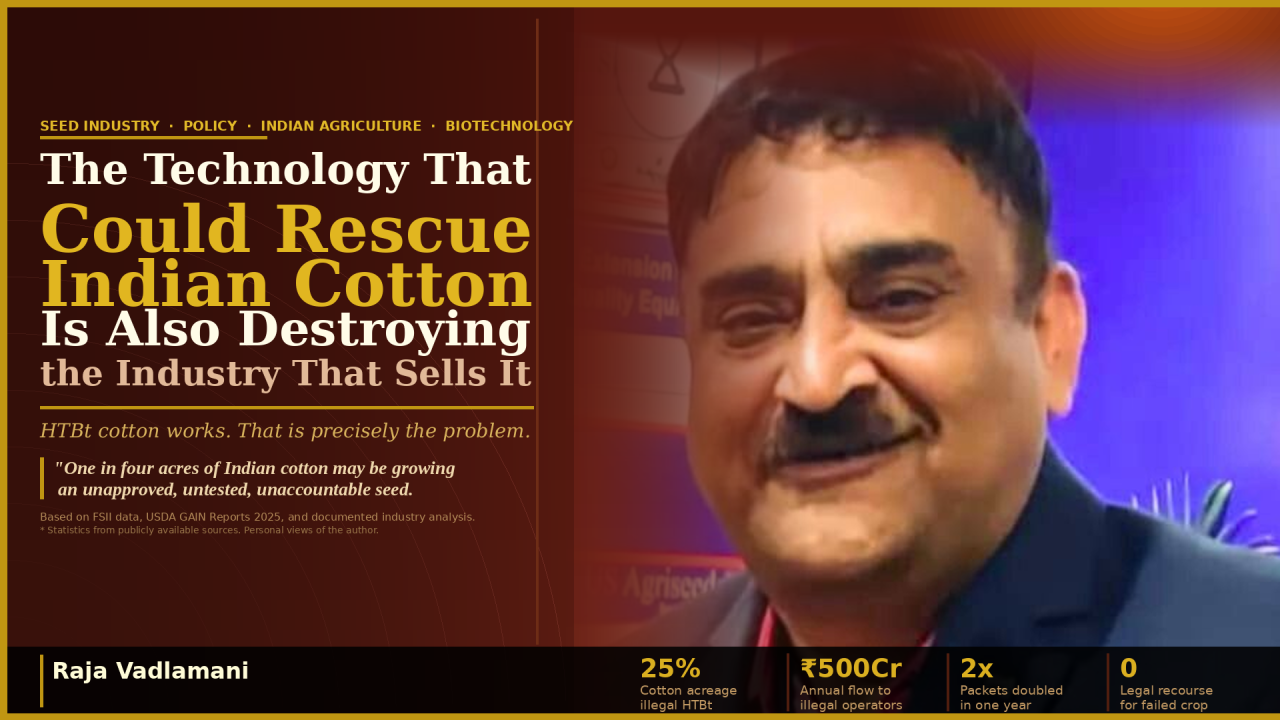
Fact two: HTBt cotton has not been approved by India’s Genetic Engineering Appraisal Committee. Every packet produced, sold, or planted is illegal. It is estimated to cover 20 to 25% of India’s 120 lakh hectare cotton acreage — with no regulatory oversight and no legal mechanism for farmers to seek compensation when a batch fails.
These two facts coexist. And between them sits one of the most consequential policy contradictions in Indian agriculture today.
How We Got Here
India’s cotton transformation after 2002 was historic.
Bt cotton changed the economics of cotton farming overnight. Production surged from 13.6 million bales in 2002–03 to 39.8 million bales in 2013–14 — a 193% increase in just over a decade. Productivity rose 87%. India became the world’s second-largest cotton producer and exporter, with net cotton exports reaching $4.1 billion.
That was the power of regulated biotechnology deployed through an organised seed industry.
Now look at where we stand.
By 2024–25, India had transitioned into a net importer of raw cotton lint — importing approximately 4.1 million bales while exporting around 1.5 million bales. India remains a large net exporter of cotton textiles, yarn, and garments — but the raw fibre deficit is a significant structural shift. Multiple forces drove this: global price competition from cheaper Brazilian and US cotton, periodic import duty waivers, erratic monsoons hitting domestic yield, and the accelerating crisis of pink bollworm resistance degrading lint quality across the cotton belt.
The seed market is not the only factor. But it is an important and underappreciated one.
The Black Market That Grew Because the Legal Market Would Not Move
The story of illegal HTBt cotton is not, at its root, a story of criminality. It is a story of regulatory paralysis meeting genuine farmer need.
Pink bollworm has developed resistance to the insecticidal proteins in currently approved Bt strains. Labour costs for manual weeding have risen sharply. HTBt cotton addresses the weeding problem directly. And much of the illegal seed in informal markets is being stacked with unapproved traits targeting bollworm — filling the gap that the regulated sector has been unable to fill through legitimate channels.
It is also important to understand how this market actually functions. Much of the illegal HTBt trade is conducted by organised regional players selling unbranded seeds — often labelled “4G” or “5G” varieties — that do deliver agronomic benefit in many seasons. This is precisely why farmer adoption has reached 20 to 25% of acreage. Farmers are not being universally deceived. They are accessing a technology they need through the only channel available.
The critical problem is not that every packet fails. It is that farmers have no legal mechanism for compensation when a batch is contaminated, mislabelled, or underperforms. There is no regulatory floor ensuring quality consistency across what is, by definition, an unaccountable supply chain.
The sale of illegal HTBt cotton seed packets more than doubled from 30 lakh in 2020 to 75 lakh in 2021. The FSII estimated that in 2021 alone, farmers paid more than ₹500 crores to illegal operators — money that did not reach registered, tax-paying, research-investing seed companies.
The Organised Sector’s Impossible Position
The legitimate seed company competing in India’s cotton seed market carries costs that the informal operator does not.
It pays GST on every transaction. It funds breeding programmes taking 8 to 12 years to deliver a commercial variety. It employs quality technicians, supervised seed growers, agronomic support teams, and cold chain infrastructure. It stands behind its product when it underperforms.
The illegal operator carries none of this. Seeds move through informal cash channels at below-market prices with no commitment of any kind.
Asking an organised seed company to compete with this is not a market challenge. It is a structural impossibility — for as long as enforcement remains weak and the regulated alternative remains unavailable.
The Farmer Paying Twice
The deepest injustice falls on the farmer.
The farmer buying illegal HTBt cotton is making a rational short-term decision. The weed management benefit is real. Access to stacked traits addressing bollworm pressure is genuinely valuable in the absence of a legal alternative.
But when a particular batch fails — through contamination, poor quality in an unmonitored supply chain, or varietal instability in informally produced material — the failure can be severe. There is no legal recourse. The seed was illegal. The seller has no registered address. The crop is in the ground and the season is gone.
The farmer saved ₹7,000 to ₹8,000 per acre on weeding. They may have lost multiples of that in yield. And there is no one accountable.
The illegal market extracts from the farmer twice: at purchase, when quality is unknown and unguaranteed; and at harvest, when there is no compensation mechanism when things go wrong.
The Environmental Risk Nobody Is Quantifying
Beyond the economics sits an environmental risk that deserves urgent attention.
The glyphosate-tolerance gene in HTBt cotton can spread through pollen to wild plant relatives under open-field conditions with no containment protocol — creating glyphosate-resistant weeds that cannot be controlled through standard herbicide management. This is not hypothetical. It is a documented crisis in the United States, Brazil, and Argentina, where glyphosate-resistant weed species now require entirely new management strategies at enormous cost.
India’s cotton belt is home to related plant species that could acquire resistance through gene flow. We are running this risk across 20 to 25% of India’s cotton acreage, with no regulatory monitoring, no containment protocol, and no management framework whatsoever.
If glyphosate-resistant weeds establish themselves across this landscape, the consequence cannot be undone by a future policy decision.
What Actually Needs to Happen
The most effective way to destroy the illegal HTBt market is to create a legal one.
Regulate, do not just ban. The GEAC must complete its assessment of herbicide-tolerant cotton traits on the basis of available evidence — including the substantial real-world data now generated by millions of acres of illegal cultivation. Environmental risk assessment of gene flow, containment protocols, and farmer protection frameworks must be part of any approval. But perpetual deferral is not a regulatory position. It is a regulatory abdication with consequences.
Reform the seed law — finally. Despite multiple attempts to update India’s seed legislation — most prominently the Seeds Bills introduced in 2004 and 2019, both of which stalled without becoming law — the legal framework remains the Seeds Act of 1966, drafted before India had a meaningful hybrid seed industry. The current Draft Seeds Bill must be enacted. Its core provisions — mandatory variety registration, pre-market testing, strengthened penalties, and traceability mechanisms — are the minimum conditions for a functional seed market that protects farmers and levels the playing field for the organised sector.
Enforce at the production source, not the farm gate. Arresting farmers for planting illegal seed is both unjust and futile. The supply chain must be disrupted upstream — at the production stage, in the districts where illegal seed multiplication is concentrated. Portable molecular testing kits deployed with agricultural field officers can identify the glyphosate-tolerance gene in plant tissue within hours, enabling identification and destruction of illegal seed crops before they reach the distribution chain.
The Closing Argument
The organised seed sector is not asking for protection from competition. It is asking for the minimum condition of a functional market: a level playing field where every participant meets the same regulatory standards and is accountable to the same legal framework.
The technology at the centre of this crisis — deployed through regulated channels, with quality assurance, environmental monitoring, and farmer protections — could genuinely improve the economics of cotton farming for millions of Indian smallholders.
Deployed through an unregulated black market, without standards or accountability, it is simultaneously undermining the industry that could deploy it responsibly.
The regulatory paralysis that created this situation has persisted for two decades. The cost — to farmers, to the organised sector, and to India’s cotton trade position — has been accumulating every season.
The window to fix this is not permanently open.
Statistics and analysis cited from FSII, USDA GAIN India Cotton Reports 2025, Mongabay India, Drishti IAS regulatory documentation, Centre for Sustainable Agriculture Seeds Bill commentary, and publicly available parliamentary records. All facts have been verified against current research. This article represents the personal views of the author.
Source: raja.vadlamani@seedworks.com