When everyone plans to grow faster than the market, the industry eventually runs out of places to hide.
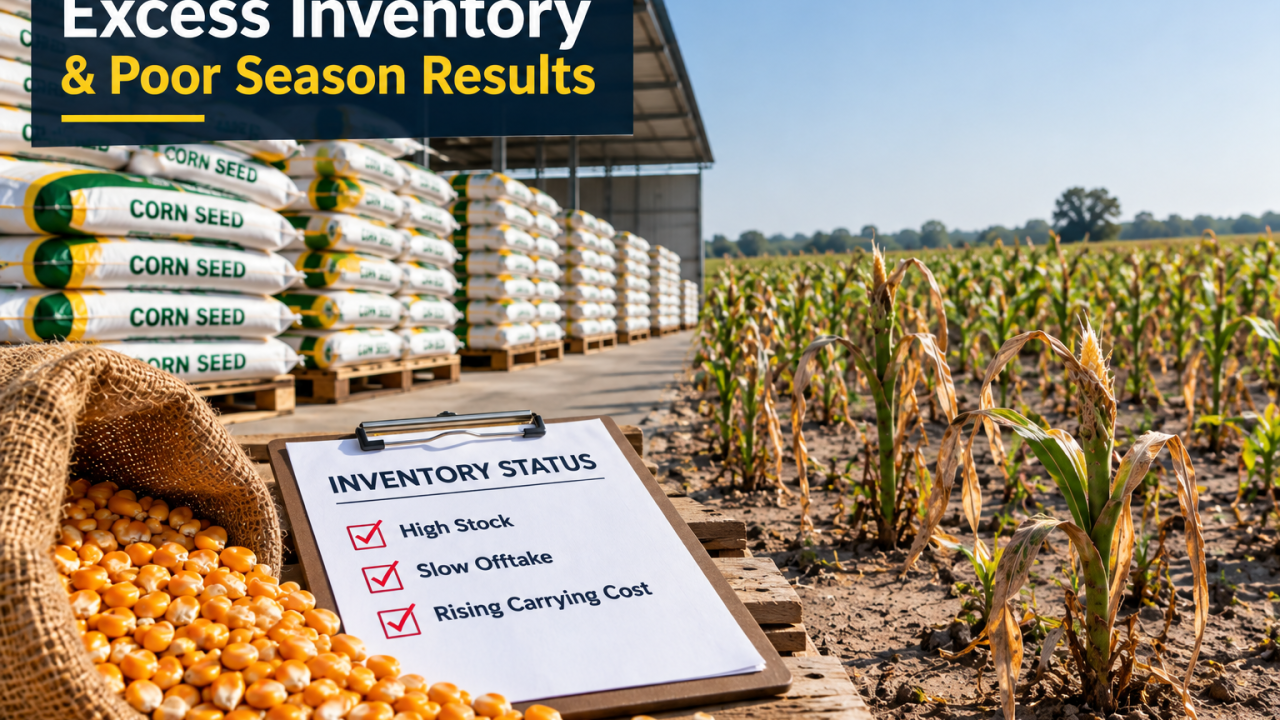
This year has been a particularly difficult one for the corn seed industry.
Across the industry, companies entered the season with ambitious volume aspirations. Production plans were expanded, acreage was committed and channel expectations were built around strong growth.
Then several things happened simultaneously.
**Aggressive targets met bumper production.
Bumper production met limited processing capacity.
Supply met shifting farmer demand.
And excess inventory ultimately met an increasingly aggressive price war.**
The result has been a perfect storm.
Here is what I believe happened—and, more importantly, what we should learn from it.
1. Overcapacity met infrastructure constraints
In our pursuit of growth, seed production acreage expanded significantly.
But production capacity is only one part of the equation.
Seed also needs to be received, dried, conditioned, graded, treated, packed, stored and dispatched—within a relatively narrow window and without compromising quality.
When seed arrivals exceed the capacity of processing and quality infrastructure, the entire system gets stretched.
And seed is not forgiving.
Rushing drying, conditioning, grading or packing can eventually show up in the farmer’s field.
The lesson is simple:
Never build production capacity faster than your ability to process, maintain quality and responsibly place the seed in the market.
2. Operational pressure can become a quality problem
When processing plants are overwhelmed, teams are forced to work under extraordinary pressure.
The consequences can include delays, inadequate drying, rushed grading, inconsistent conditioning, packaging issues and, ultimately, quality concerns.
And when quality fails, the cost is much bigger than the value of the affected inventory.
**You damage farmer confidence.
You damage the channel relationship.
And you damage the brand.**
In the seed industry, trust takes years to build and can be lost in one season.
3. Weather can turn a planning assumption upside down
Agriculture has one variable that no spreadsheet can completely control:
Nature.
Weather volatility can change sowing windows, crop choices, acreage and farmer behaviour almost overnight.
A seed that was expected to be in high demand can suddenly face a shortened planting window.
And unlike many other products, seed has a biological clock.
If the planting opportunity passes, inventory cannot simply wait indefinitely for the next cycle.
This makes agility in demand and supply planning absolutely critical.
4. Then comes the price-war trap
Once supply exceeds genuine demand, the competitive response becomes predictable.
More schemes.
More discounts.
More rebates.
More credit.
More pressure on distributors.
And eventually, price becomes the primary differentiator.
This creates a dangerous downward spiral.
The company wants to clear inventory.
The distributor wants to protect his margin.
The competitor responds with an even more aggressive offer.
And soon the entire channel is forced to operate at economics that are difficult to sustain.
The market may clear the inventory—but at what cost?
5. Perhaps the biggest issue: We forgot the mathematics of the market
This, to me, is the most important lesson.
Every company has the right to set ambitious targets.
But the sum of individual company ambitions cannot become the industry’s market demand.
If the total plantable area, seed rate, hybrid adoption and replacement rate indicate a certain market size, that should be the starting point for industry planning.
Instead, if every company assumes significant incremental market share, the collective production plan can become disconnected from reality.
And eventually, the market corrects that imbalance.
Usually painfully.
We need to start thinking differently.
Instead of asking only:
“What is our growth target?”
we should first ask:
“What is the realistic gross industry demand?”
Then:
“What is our sustainable share of that market?”
That simple change in thinking could prevent significant value destruction.
What should we do differently?
1. Move from company-level optimism to industry-level market intelligence
The industry needs better estimates of:
- Total plantable acreage
- Hybrid adoption
- Seed replacement
- Seed rate
- Regional demand
- Product and maturity-wise demand
- Channel inventory
- Weather-driven changes in acreage
The objective is not to reduce competition.
It is to make competition more rational.
2. Align production with processing capacity
Production planning cannot stop at acreage.
We need to ask:
**Can we harvest it?
Can we dry it?
Can we process it?
Can we condition it?
Can we maintain quality?
Can we store it?
Can we sell it within the planting window?**
If the answer to any of these is no, additional production may actually destroy value.
3. Measure sell-through, not just sell-in
A booking is not consumption.
A distributor taking stock is not farmer demand.
The real measure is:
How much seed ultimately gets planted by the farmer?
That is where genuine market demand resides.
4. Build agility into the supply chain
Weather volatility is becoming an increasingly important factor in agriculture.
We therefore need supply chains that can respond quickly to changes in acreage, sowing windows and farmer preferences.
Rigid annual plans alone may no longer be sufficient.
5. Compete on value, not just price
There is nothing wrong with aggressive competition.
But the best form of competition should be around:
**Genetics.
Yield.
Quality.
Technology.
Agronomy.
Farmer experience.**
If the only competitive weapon left is price, the industry has already started losing.
The bigger opportunity
I don’t believe the answer is to become conservative about corn.
The long-term opportunity remains significant.
The answer is to become more disciplined about growth.
We need to replace:
“How much can we produce?”
with:
“How much does the farmer actually need—and how much can we deliver without compromising quality or value?”
We need to replace:
“How much can we push into the channel?”
with:
“How much can the market genuinely consume?”
And perhaps most importantly, we need to replace:
“How do we beat our competitor?”
with:
“How do we grow the category sustainably?”
The seed industry is too important to become a victim of its own ambition.
This year’s experience should become a learning opportunity.
Compete fiercely at the company level.
Collaborate intelligently at the industry level.
Plan production based on realistic demand.
Build capacity around quality.
And never forget that the ultimate customer is the farmer.**
Because when the industry wins, the farmer wins.
And when the farmer wins, the seed industry wins for the long term.
What are your thoughts? Has our industry become too focused on individual company targets and not enough on the overall market equation?
SeedIndustry #Corn #Maize #SeedBusiness #Agribusiness #Agriculture
Source: ashok.jha@dayalgroup.com