Dario Amodei recently made an unusually direct observation about the promises surrounding artificial intelligence and medicine:
“At this point, saying that AI will cure cancer is more a cliché than it is inspiring, and most people think it is deceptive. The thing that will work is actually curing cancer.”
He added that perhaps the most accurate criticism of AI companies, including Anthropic, is that they have not yet delivered on their major promises to benefit the world.
The statement deserves attention because Amodei has himself offered one of the field’s most ambitious forecasts. In his 2024 essay Machines of Loving Grace, he predicted that AI-enabled biology and medicine could compress 50 to 100 years of scientific progress into five to ten years. His recent comment does not necessarily withdraw that prediction. It does, however, introduce a distinction often missing from discussions of AI and drug discovery: the difference between describing technological potential and demonstrating therapeutic results.
The growing promise of AI-driven cures
Over the past several years, technology leaders have repeatedly presented AI as a possible route to curing disease. In 2023, Priscilla Chan and Mark Zuckerberg wrote that AI could significantly advance the Chan Zuckerberg Initiative’s goal of helping the scientific community “cure, prevent, or manage all disease” by the end of the century.
In 2025, Google DeepMind CEO Demis Hassabis went considerably further, suggesting that curing all disease might be within reach “within the next decade or so.” Sam Altman has written that we are moving from being impressed by AI’s ability to make medical diagnoses to asking when it will “develop the cures.” He later speculated that, with ten gigawatts of computing capacity, AI might determine how to cure cancer.
These statements differ substantially in scope, timescale and confidence. A century-long institutional goal is not the same as a near-term forecast, and a speculative statement about cancer is not equivalent to a prediction about all diseases. Nevertheless, taken together, such claims reinforce a powerful narrative: once sufficiently capable models are combined with enough data and computing power, biological discovery will accelerate in much the same way as software development or semiconductor design.
There is a serious idea beneath this narrative. Drug research contains many processes that can (and should) become more systematic, quantitative and reproducible. AI can help researchers analyse complex datasets, identify possible targets, generate molecules, predict molecular properties, prioritise experiments and improve clinical-trial operations. Automation can increase experimental throughput, while better models may reduce the number of compounds that must be synthesised and tested. The problem begins when becoming more like engineering is confused with becoming a simple engineering task.
Biology does not provide a stable specification
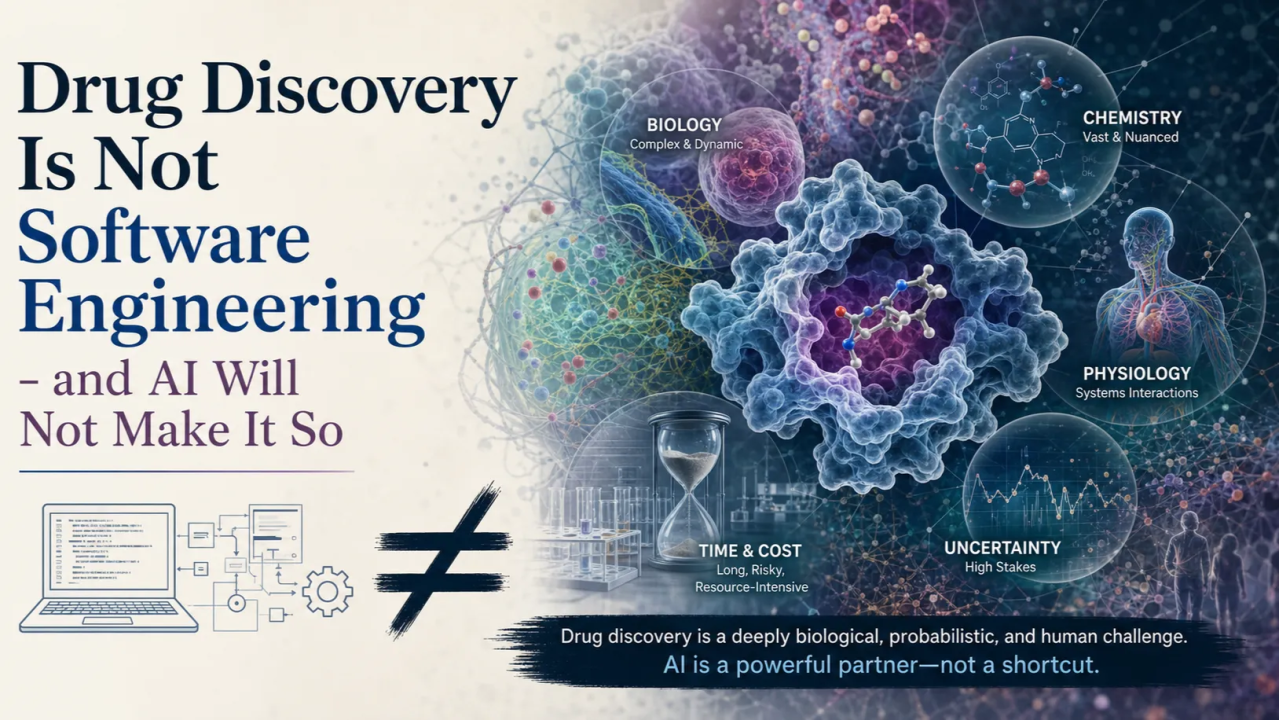
Drug discovery is not equivalent to writing software against a defined specification. In software engineering, the intended function can normally be described in advance. The system can be tested repeatedly at relatively low cost, and failures can often be traced to particular components. The environment is complex, but it is largely constructed by humans and governed by rules they have specified.
Biology offers none of these conveniences. Living systems are only partially understood. Their components interact across molecular, cellular, tissue and whole-organism levels. Their behaviour varies according to genetic background, age, disease stage, environment, treatment history and factors that may not yet have been identified.
A protein may appear to be a promising target in a computational model and still prove irrelevant, unsafe or inaccessible in patients. A molecule may bind to its intended target but fail because it is poorly absorbed, rapidly metabolised, toxic to another organ or unable to reach the required tissue. An intervention may work in a cell line and fail in an animal, or work in an animal and fail in humans. This is to demonstrate the incomplete causal understanding of dynamic, adaptive and heterogeneous systems.
A generated molecule IS NOT yet a medicine
The phrase “drug discovery” can itself be misleading in conversations about AI. Generating a plausible molecular structure is not the same as discovering a drug. Discovering a candidate is not the same as developing a medicine. And developing a medicine is not the same as demonstrating that it meaningfully improves patients’ lives.
Molecular generation is only one part of a process that includes target validation, assay development, medicinal chemistry, pharmacology, toxicology, formulation, manufacturing, patient selection and several phases of clinical evaluation. AI may substantially improve one or more of these stages without removing the constraints imposed by the others.
It can generate thousands of attractive designs, but experiments must determine which behave as expected. It can identify patterns in patient data, but clinical studies must establish whether an intervention is safe and effective. It can help researchers manage uncertainty, but it cannot abolish uncertainty by increasing computational scale.
This is why the strongest version of the engineering analogy is misleading. Drug discovery is much more difficult than simply a search for the correct design within a fully specified space. In many cases, we do not yet understand the design space, the objective function, or all the constraints.
The biotechnology sector is more cautious than the rhetoric suggests
Some of the clearest explanations of these limits come from leaders of AI-native biotechnology companies themselves. Marc Tessier-Lavigne, CEO of Xaira Therapeutics, has argued that AI could transform drug discovery from a “broken, artisanal” activity into something closer to an engineering discipline. Yet he also emphasises that AI-generated candidates must undergo the same preclinical and clinical testing as conventionally produced candidates. The model proposes; the experiment verifies.
Stef van Grieken of Cradle describes biology as moving “from discovery to design.” But Cradle relies on a laboratory feedback loop in which experimental results continuously refine the AI. Its approach is not based on eliminating experiments, but on making each experimental cycle more informative.
Jacob Berlin of Terray Therapeutics is more explicit. He rejects the idea that drug discovery can become a software-only process, arguing that large, precise, and iterative experimental datasets remain essential. In his view, the durable advantage lies at the intersection of experimentation and machine intelligence, not in models operating independently of the laboratory.
Gleb Kuznetsov of Manifold Bio has predicted a dramatic narrowing of the interval between molecular design and first-in-human testing. At the same time, he acknowledges that testing will remain necessary and that such acceleration will apply to some applications rather than all of drug development.
These qualifications reveal the operational model emerging within serious AI-biotechnology companies: not biology without experiments, but tighter and more productive cycles between computation and experimentation.
The data do not simply exist
AI models learn from observations, yet biological data are often limited, inconsistent, and highly dependent on experimental context. Unlike language models, which can be trained on enormous quantities of existing digital material, biological models cannot absorb a complete record of how living systems work. That record does not exist. Much of the necessary data must first be generated through carefully designed experiments, often using specialised equipment, animal models and eventually human participants.
Quantity alone is insufficient. Biological data can be noisy, difficult to standardise and affected by differences in laboratory protocols, measurement technologies and sample populations. A model may learn patterns that are technically real but clinically irrelevant, or artefacts created by the data-generation process rather than by the biology. Even very large datasets may be descriptive rather than causal. They can show that a molecular feature is associated with a disease state without demonstrating whether changing it will improve the disease. As Tessier-Lavigne has noted, models trained on descriptive cellular data cannot reliably answer causal questions without appropriate perturbational data. Better algorithms matter. But so do the design, standardisation and interpretation of the experiments that provide them with evidence.
The clinical boundary
Clinical development introduces an even firmer boundary between computational promise and medical reality. Patients are heterogeneous. Diseases described under one name may consist of several biological subtypes. Treatment effects may be smaller or less durable than preclinical evidence suggests. Safety cannot be treated as a secondary optimisation objective because rare or delayed adverse effects may become visible only after treatment reaches larger and more diverse populations.
Clinical trials are often criticised as bureaucratic obstacles. Some of that criticism is justified: trials can be unnecessarily slow, expensive and operationally inefficient. AI may improve protocol design, patient recruitment, site selection, monitoring and statistical analysis. Nevertheless, the fundamental purpose of clinical evaluation is not administrative. It is to protect patients and distinguish plausible mechanisms from interventions that genuinely improve health.
Najat Khan, CEO of Recursion, has described the objective of using AI end to end to produce better targets, better molecules and faster, more repeatable development programmes. Yet she also states that “the rubber hits the road in the clinic.” That is precisely where an engineering narrative must confront biological and medical evidence.
A model can predict. A laboratory can provide supporting evidence. Only clinical evaluation can show whether the proposed medicine works adequately in patients.
AI can still transform drug research
None of this means that AI will have only a marginal effect on drug discovery. On the contrary, its impact may be substantial.
The combination of generative models, high-throughput experimentation, laboratory automation and richer patient data could make research programmes faster, more selective and more informative. AI may help scientists reject weak hypotheses earlier, explore chemical spaces that conventional methods cannot efficiently reach and design experiments that generate more useful causal information. It may also reduce repetitive work and enable smaller teams to manage more complex programmes.
Parts of drug discovery could become considerably more industrialised and reproducible. Some stages may eventually resemble engineering disciplines much more closely than they do today.
But the most productive conception of AI is not an oracle converting computing power into cures. It is one component of a broader learning system connecting models, experiments, scientists, clinicians and patients. The quality of that system will depend not only on how many candidates it generates, but on how effectively it identifies mistakes and learns from failure. In biology, failure is not an inconvenient deviation from the process. It is one of the main sources of information.
We need better measures of progress
This distinction should change how progress is communicated. The number of generated molecules, model parameters or predicted targets is not evidence that a disease has been cured. Neither is the speed at which a company produces a development candidate. Even reaching clinical trials remains an intermediate achievement rather than a therapeutic outcome.
Insilico Medicine, for example, has reported reducing the time required to reach a development candidate to approximately one year. That is an impressive operational result. At the time of the statement, however, none of its experimental medicines had been approved for sale. This does not invalidate the platform. It illustrates the distance between accelerating an early research stage and delivering a successful treatment.
The meaningful measures of progress are more demanding: reproducible experimental validation, better translation from laboratory models to humans, improved probabilities of clinical success, meaningful patient outcomes, regulatory approval and evidence that approved treatments remain safe and effective in practice.
The central question is not whether AI can produce more hypotheses. It almost certainly can. The question is whether the entire system can convert those hypotheses into better medicines with greater reliability.
Why the language matters
The language used by technology leaders influences investment, public expectations and scientific priorities. Claims about curing all diseases may attract attention and capital, but they can also obscure where the real bottlenecks lie.
If the industry assumes that the central problem is insufficient computing power, it may underinvest in experimental infrastructure, longitudinal patient data, assay quality, translational science and clinical expertise. If failures are interpreted mainly as evidence that a larger model is needed, the field may overlook a more basic possibility: the biological hypothesis may be wrong, the measurement inadequate, or the data unable to support a causal conclusion. Rather than merely excessive optimism, the danger lies in allocating resources according to an incomplete model of how medicines are created.
The engineering metaphor is useful when it encourages greater reproducibility, automation and discipline. It becomes dangerous when it implies that biology is already sufficiently understood and the remaining challenge is mainly one of computational execution. We are not yet in that world.
From promises to evidence
Amodei’s recent statement points in a useful direction. “Actually curing cancer” requires more than replacing pessimistic rhetoric with optimistic rhetoric. It requires a culture in which claims are proportional to evidence and computational achievements are clearly distinguished from therapeutic ones.
AI companies entering biology should be judged not only by benchmark performance or the elegance of their models. They should be judged by whether their systems improve decisions throughout research and development: whether programmes advance faster without sacrificing quality, weak candidates are rejected earlier, and more treatments ultimately deliver meaningful clinical benefits. Drug discovery can become more systematic without becoming simple. It can adopt engineering methods without ceasing to be an experimental science.
AI may help us understand and manipulate biology with far greater precision. But every computational proposal must eventually meet a living system, and living systems do not follow the clean abstractions of software. The most credible future is therefore neither traditional drug discovery with a superficial AI layer nor fully automated discovery conducted entirely in silico. It is an integrated process in which computation and experimentation continually challenge and improve one another.
That vision may be less dramatic than the promise that AI will soon cure every disease. It is also far more likely to produce the results that patients are waiting for.
Source: LinkedIn – Serhii Vakal