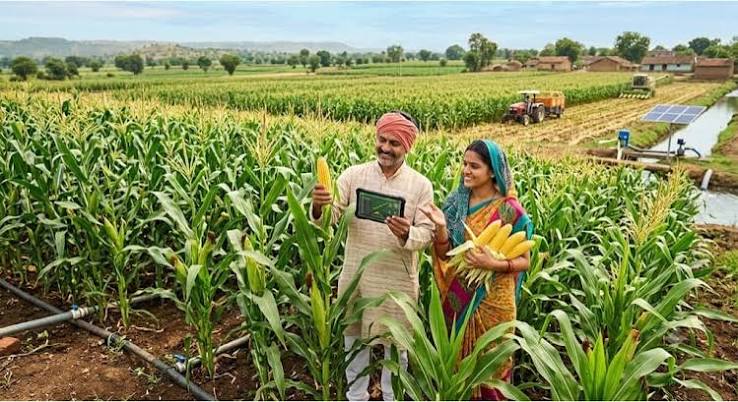
Maize is emerging as a potential next step in India’s “green revolution,” with output expanding faster than traditional staples. Over the past decade, production has risen from 22.57 million tonnes in marketing year (MY) 2015/16 to 55.09 million tonnes in 2025/26. That implies an average annual growth rate of about 9.3%, more than double the growth of rice and more than three times that of wheat. For a country where rice and wheat have long anchored food security, the pace of maize expansion signals a structural shift in how incremental productivity is being achieved.
India’s maize output accelerates
Growth without classic price supports
According to Professor Ramesh Chand of ICRIER, the scale of maize’s advance is notable because it has occurred without the long-standing price support architecture that underpins rice and wheat. This points to efficiency gains and technological change—rather than subsidy-driven expansion—as the principal drivers. For investors and policymakers, the implication is that yield improvements, input optimization, and market-linked incentives are proving sufficient to scale a cereal outside the traditional support net.
Resource and environmental recalibration
Analysts highlight an ecological dimension to maize’s rise. Shifting some acreage from rice to maize, particularly in northwestern India, can help alleviate groundwater depletion and soil degradation associated with the intensive rice–wheat rotation. By reducing environmental pressure in regions where water tables are under stress, maize offers a pathway to sustain output growth while moderating resource use—an increasingly material consideration for long-term agricultural planning.
Signals for global markets
India’s acceleration in maize production broadens the geography of supply growth in a commodity still dominated by the Americas and parts of Eastern Europe. As domestic output scales, India’s role in regional trade could evolve, with implications for nearby feed and processing markets and for price discovery in Asia. For global buyers and sellers, a large producer adding volume at a compound pace of roughly 9.3% over a decade can influence intra-Asian flows, seasonal arbitrage, and the resilience of supply chains during weather or logistics disruptions elsewhere.
Technology and diversification as the growth model
The trajectory suggests India’s agricultural gains will rely less on expanding resource use and more on crop diversification and technology adoption. In that framework, maize functions as a test case for a more productive and sustainable model of development, aligning yield growth with resource stewardship. If sustained, the combination of market-led incentives, technology diffusion, and diversification seen in maize could reshape not only India’s cereal balance but also the regional contours of maize supply.
Source : Cropgpt