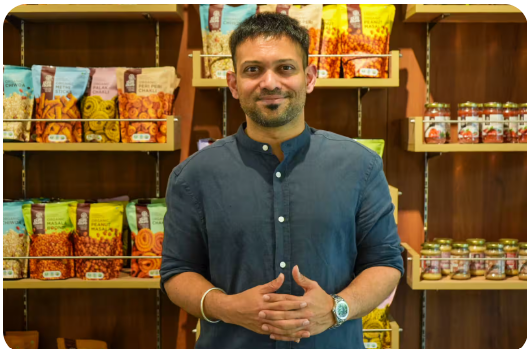
India’s organic food market is expanding rapidly, valued at about $2.3 billion in 2025 and projected to reach $11.3 billion by 2034, according to IMARC. Against this backdrop, Surya Shastry, founder and managing director of Phalada Organic Consumer Products Pvt. Ltd, makers of the Pure & Sure brand, is pursuing steady, specialised growth rather than rapid portfolio expansion. With 150 SKUs covering most daily household needs, Shastry says strong retail foundations, rising consumer awareness and improving farmer supply are helping the company navigate competition and discounting while sustaining double-digit growth.
The Indian organic food market has been burgeoning. According to the latest available industry study, the market was growing at approximately 20 percent CAGR. The IMARC Indian Organic Food Market study also states that the market was valued at approximately $2,303.31 million in 2025 and is projected to reach $11,296.09 million by 2034.
ET HospitalityWorld visited the production unit of Phalada Organic Consumer Products Pvt. Ltd, makers of the Pure & Sure brand, which has been around for several years, and spoke with Surya Shastry, founder and MD, about the sector and what his company is doing.
Having expanded with bricks-and-mortar stores just before the pandemic, Shastry said the brand faced the same challenges as other retailers, though the business itself was sustained by growing demand for organic food across the market.
Currently, around 65 percent of their sales are online.
“Quick commerce is growing really fast. I think that adaptation was something that got accelerated due to COVID, but even otherwise, quick commerce in the last few years has made growth in the category even faster. A large chunk of our business still comes from retail and that’s been consistently built over the many years that we’ve been in existence,” Shastry said.
His company currently offers 150 SKUs and has been slowly adding new products such as low-GI rice and Khapli atta.
“These kinds of specialised products are something that we have added into the portfolio, but we haven’t gone into a lot of large-scale expansion in our offering as such, because we already cover close to about 80% of what a household would require for their daily consumption,” he said.
Speaking about the HoReCa sector, he said they had still not seen large-scale pick-up from larger hospitality companies. The snacks that the company produces have made some inroads in hotels’ in-room offerings.
“In the HoReCa markets specifically, Goa does really well for us. A lot of cafes and restaurants reach out to us and order from us for their space, which could also be because customers are more aware of organic food,” he added.
Competition comes from both the larger players that have entered the organic food market and more specialised smaller brands. Even so, Shastry said: “I still feel we have hardly scratched the surface of the market opportunity that’s there. A larger number of brands coming in means the supermarkets are taking this category more seriously. They’re giving more shelf space. The consumers are getting more aware of the benefits of organic.”
On margins in the business, he said that initially larger retailers would push for higher margins in a sector they felt was very niche, but with the growing popularity of organic food they have started to take the products more seriously, which has allowed Shastry to negotiate better margins.
“On the farmers’ side, supply has increased considerably over the last few years, with the government doing a lot to promote organic farming, which has helped to secure better margins than what it used to be,” he added.
The company has seen year-on-year growth of around 45 percent compared with last year, but Shastry warned that a larger chunk of that came from online channels, where the level of discounting makes predicting unit economics much harder.
On the subject of external funding, he said they were constantly approached by funds but were not interested in taking the business in that direction.
“We’ve been bootstrapped, and we also have a good chunk of export business, which is a good-margin business for us. We are able to manage without any external funding as of now,” Shastry concluded.
Source: Economictimes