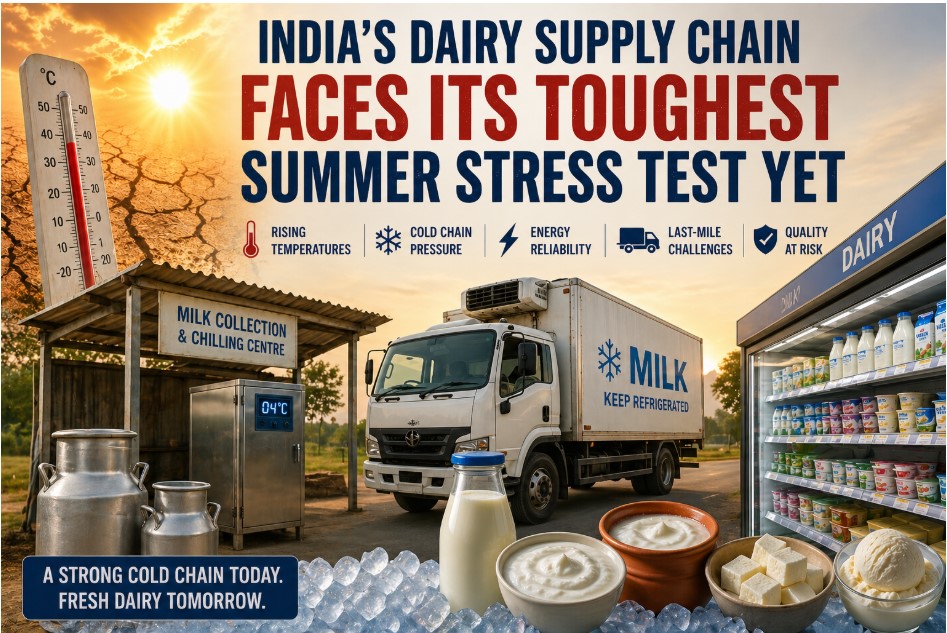
India’s dairy sector is walking into a tough summer, and this time, the real challenge isn’t demand. It’s the supply chain holding everything together.
As temperatures climb, the pressure on dairy logistics is rising sharply. Consumption patterns have evolved beyond loose milk to packaged and value-added products like curd, lassi, paneer, flavoured milk, and ice cream. These products are far more sensitive to temperature, which means the cold chain can’t afford even brief lapses.
What makes dairy especially complex is that refrigeration doesn’t start at the warehouse; it starts at the farm. Milk has to be chilled almost immediately after collection, then kept within a narrow temperature range through aggregation, processing, transportation, and finally retail. Any break in this chain, even for a short time, can impact quality and shelf life.
This summer, with forecasts pointing to intense and prolonged heatwaves, the margin for error is shrinking. Higher temperatures accelerate spoilage and increase the load on refrigeration systems. Deliveries need to be faster, cooling needs to be more consistent, and the dependence on reliable power becomes even more critical, especially in rural and semi-urban areas where infrastructure gaps still exist.
At the same time, demand is not slowing down. India’s appetite for dairy is growing, particularly in the chilled and premium segments. But the infrastructure supporting this growth, from village-level chillers to refrigerated trucks and retail cooling units, is still catching up. The strain isn’t coming from weak demand but from systems being pushed beyond their original capacity.
The risks are very real. Dairy is unforgiving when it comes to temperature deviations. A small slip can lead to spoilage, financial losses, and damaged consumer trust. In peak summer conditions, maintaining a steady 2-8°C across the chain becomes both a technical and operational challenge.
The last mile continues to be the most unpredictable part of the journey. While large processing facilities and primary logistics have improved, retail-level refrigeration and handling practices remain uneven. A well-managed upstream supply chain can still falter if the final leg fails to maintain temperature integrity.
Energy reliability adds another layer to the problem. Cooling infrastructure depends heavily on consistent power, and even short outages can disrupt the entire cycle. In that sense, the cold chain is no longer just a logistics issue; it is closely tied to energy infrastructure as well.
That said, not all players are equally exposed. Companies that have invested in stronger cold-chain networks, real-time monitoring, and decentralised chilling are better prepared. For them, a harsh summer can actually become an opportunity to stand out in reliability and availability.
This season will likely draw a clear line. It will show which supply chains are built to handle stress and which ones still rely on patchwork systems. For India’s dairy industry, the real test this summer isn’t just about keeping products cold; it’s about proving the resilience of the entire supply chain.
Source : Logisticsinsider