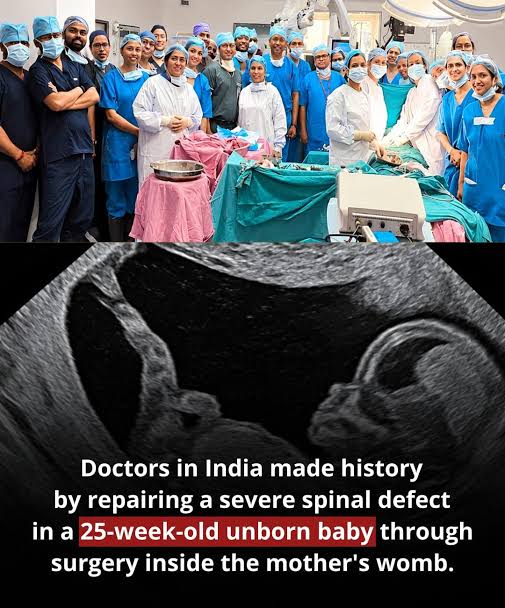
Doctors at AIIMS, New Delhi, have achieved a major medical milestone by performing India’s first open fetal surgery to repair a baby’s spinal defect before birth. The complex operation lasted six hours and was carried out on November 12, at 25 weeks of pregnancy. The procedure marks a significant development in India’s fetal medicine capabilities, bringing new hope to families whose unborn babies are diagnosed with serious birth defects.
What makes this achievement particularly significant is its timing. Instead of waiting until birth to repair the defect, doctors intervened while the baby was still developing.
What happened during India’s first fetal surgery?
The AIIMS team performed an open fetal surgery to treat a condition called myelomeningocele, the most severe form of spina bifida. The procedure involved repairing an opening in the baby’s lower spine through which the spinal cord and its protective coverings had protruded.
More than 30 doctors, nurses and specialists participated in the six-hour operation. The team used advanced microscopy and continuous ultrasound guidance to perform the delicate procedure.
According to AllMS, both the mother and the fetus are stable and recovering well.
What is myelomeningocele and why is it dangerous?
Myelomeningocele is a congenital condition that develops when the neural tube, which eventually forms the brain and spinal cord, does not close completely during early pregnancy.
As a result, part of the spinal cord and its surrounding membranes protrude through an opening in the backbone. This can expose delicate nerves to damage.
Children affected by this condition may experience paralysis, problems controlling their bladder and bowel movements, and hydrocephalus, a condition involving excess fluid in the brain.
Why did doctors operate before birth?
Traditionally, doctors repair this spinal defect after delivery. However, the exposed spinal tissue can sustain further damage during pregnancy.
Fetal surgery attempts to protect the developing nerves before birth. Evidence from the US-based Management of Myelomeningocele Study (MOMS) found that prenatal surgery reduced the need for a brain-fluid shunt and improved certain motor outcomes in carefully selected cases.
However, this is not a complete cure. Children may still require surgery, rehabilitation and long-term medical support.
What makes this achievement important for India?
The procedure required more than five weeks of planning, detailed fetal imaging, counselling and surgical preparation. Specialists from neurosurgery, maternal-fetal medicine, obstetrics, anaesthesia, plastic surgery and neonatology worked together.
Another important aspect was affordability. The surgery was provided free of cost under the government’s Janani Shishu Suraksha Karyakram (JSSK).
This is significant because access to highly specialised fetal treatment can otherwise be financially challenging for families.
Can such birth defects be prevented?
Fetal surgery offers treatment in selected cases, but prevention remains equally important.
The neural tube develops very early in pregnancy, often before a woman knows she is pregnant. The National Health Mission’s 2024 Comprehensive Emergency Obstetric and Newborn Care guidelines recommend 400 micrograms of folic acid daily before pregnancy and through the first 12 weeks after conception. The guidelines state that this can reduce neural tube defects by nearly 75%.
AIIMS’ achievement is a milestone, but it also highlights an important message: early pregnancy care, nutritional awareness and access to specialised medical services can make a meaningful difference.
Source: Timesofindia