Ask any seed company executive what they sell, and the answer comes quickly: quality seed. More bags. Better market share. It is a model that has defined the industry for generations — and it has worked extraordinarily well. Global seed markets have grown into a multibillion-dollar industry built entirely on that simple logic.
But something is quietly shifting beneath the surface. And the companies that see it early will define the next era of agriculture.
The question worth asking today is not how many bags a seed company sells. The deeper question is this: what environmental outcome does every seed planted actually create?
The Hidden Product Inside Every Bag
Seeds Have Always Created Environmental Value. We Just Never Priced It.
Consider two rice hybrids sitting side by side in a catalogue. Both deliver comparable yields. But one requires 30% less irrigation water, emits significantly lower methane during cultivation, and maintains yield under drought stress. In a world of water scarcity and climate pressure, are these two seeds actually worth the same price?
The agricultural value chain is beginning to answer that question — and the answer is no.
The Carbon Market Signal
Carbon Credits Are Already Rewarding Crop Genetics — Indirectly
Voluntary carbon markets are growing fast. Agriculture and land use represent one of the largest untapped pools of creditable carbon reductions globally. And increasingly, the genetics of the seed planted is a primary determinant of whether a farm qualifies for a carbon payment or not.
Market Signal
A Leading Global Agri-Sciences Company — European Farm Network
One of the world’s largest agricultural input companies has moved beyond product sales into measuring and rewarding sustainability outcomes at the farm level: soil carbon sequestration, reduced synthetic inputs, and biodiversity indicators across its European farm network. The company is not just selling genetics. It is building the infrastructure to verify and eventually monetise the environmental footprint of those genetics. This is a preview of where the entire industry is heading.
Market Signal
A US-Based Agricultural Biologicals Company — Carbon Credit Programme
A US-based company built one of the first large-scale agricultural carbon programmes, enrolling thousands of farmers and issuing verified carbon credits based on practices including cover cropping, reduced tillage, and improved soil health. Critically, the crop inputs used on those farms directly influenced the carbon outcomes measured. The seed is the entry point. The carbon credit is the monetised outcome. It is an architecture more seed companies are now studying closely.
“The same field that produces seed/grain today could generate tomorrow’s carbon credits, water credits, biodiversity certificates — or all three simultaneously.”
Water as a Currency
In a Water-Scarce World, Drought Tolerance Has a Market Price
Water is becoming the new oil for agriculture. Aquifer depletion in the Indo-Gangetic Plains, escalating irrigation costs across South Asia and Africa, and increasing regulatory pressure on water use are not abstract risks — they are present-day constraints reshaping what crops farmers can afford to grow and how.
Market Signal
A Major Hybrid Developer — Water-Use Efficiency as a Primary Breeding Objective
A leading corn and cereal hybrid developer has made water-use efficiency a first-class breeding objective alongside yield — not merely a secondary trait. Its drought-tolerant hybrids have demonstrated yield stability under water stress that translates directly into lower irrigation requirements. Importantly, the company has begun communicating these traits not just agronomically but economically — in terms of input cost savings and risk reduction for the farmer. The direction is unmistakable: water efficiency will be priced into genetics.
Biodiversity as a Balance Sheet Item
Regulation Is Changing What Food Companies Will Buy
Food companies supplying European and global markets are facing a new reality: their agricultural supply chains must increasingly demonstrate biodiversity outcomes, not merely food safety compliance. The EU Nature Restoration Law, the Corporate Sustainability Reporting Directive, and growing pressure from institutional investors are pushing food companies to trace and verify the ecological impact of their sourcing. This pressure flows directly upstream — to seeds.
Market Signal
A Global Crop Protection and Seeds Group — Biodiversity Commitment Programme
A major global seeds and crop protection group has committed to measurable biodiversity outcomes across its supply chain and farm network — including pollinator corridors, soil biodiversity indicators, and wildflower habitat targets. These are not merely CSR gestures. They are infrastructure for a future where the variety a farmer plants generates not just yield but a biodiversity score that a downstream food company can report to its investors and regulators. The seed company of tomorrow will be a biodiversity outcome provider.
What Comes Next
The Seed Catalogue of 2035 Will Look Very Different
Imagine a seed catalogue that lists alongside every variety: its carbon reduction potential per acre, its water-saving coefficient, its nitrogen-use efficiency rating, its climate resilience score under projected 2050 temperatures, and its biodiversity impact index.
This is not science fiction. The data infrastructure to produce such a catalogue is being assembled today — through digital field records, satellite monitoring, soil sampling networks, and on-farm IoT sensors. Seed companies already manage some of the most sophisticated farmer networks in existence. They have the agronomic expertise, the traceability systems, and the field presence to become verifiers of environmental outcomes at scale.
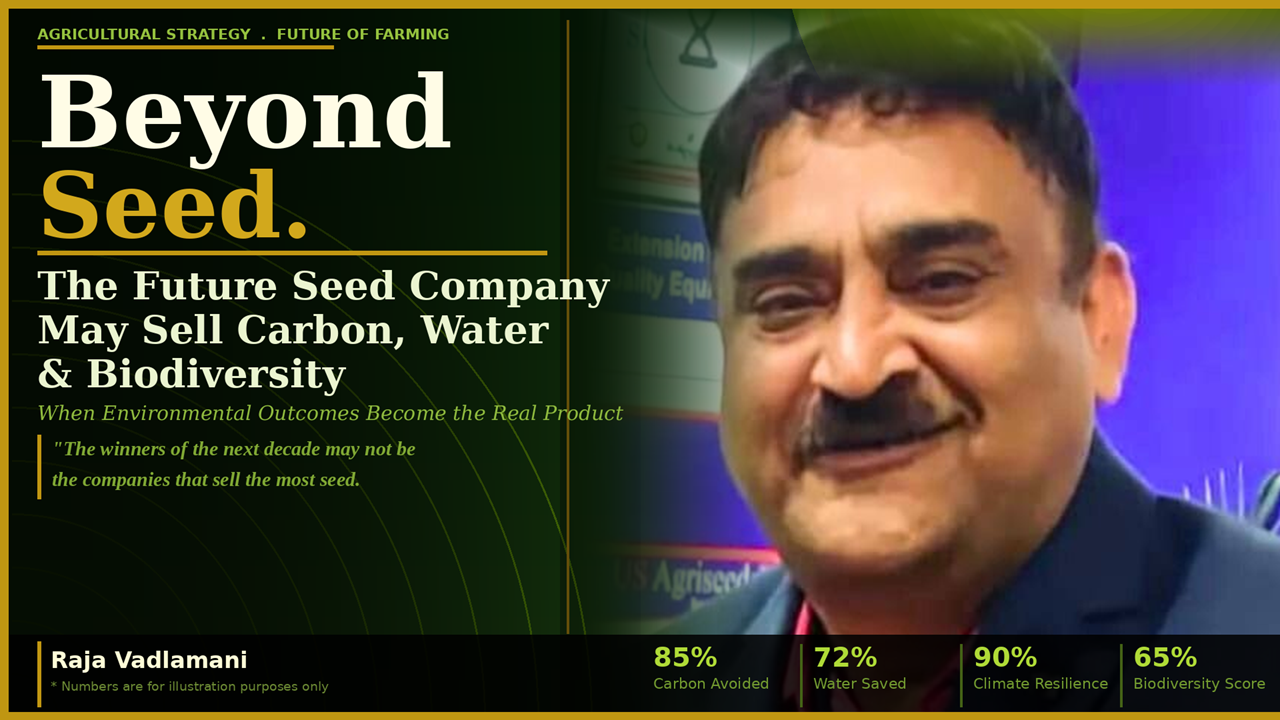
“The winners of the next decade may not be the companies that sell the most seed. They may be the companies that generate the most measurable environmental value per acre.”
The Strategic Imperative
Three Questions Every Seed Industry Leader Should Be Asking
The transition from selling planting material to selling environmental outcomes will not happen overnight. But the foundations are being laid now. For seed industry leaders, three questions are worth sitting with:
First: Are your breeding programmes tracking environmental footprint metrics — carbon, water, nitrogen — alongside yield and disease resistance? If not, you are optimising for a market that is slowly being repriced.
Second: Do you have the data infrastructure to verify and monetise the sustainability outcomes your genetics create? The genetics alone are insufficient. The verification architecture is where the economic value will be captured.
Third: Are you building relationships with the carbon markets, food companies, and regulators who will ultimately pay for those outcomes? The seed company of the future will have a more complex stakeholder map than the seed company of today.
At SeedWorks
We believe the seed of the future is not just a planting input — it is an environmental promise. Every variety we develop, every hybrid we put in a farmer’s hands, carries within it the potential to reduce carbon, save water, restore soil, and protect biodiversity.
That potential has always been there. What is changing is the world’s ability — and willingness — to measure it, value it, and pay for it.
At SeedWorks, we are not waiting for that future to arrive. We are working toward it.
— Raja Vadlamani
Source : linkedin – Raja Vadlamani (raja.vadlamani@seedworks.com)